
Electrostatic Discharge (ESD) Modern Challenges, Regulations, Advanced Protection Strategies, and Emerging Applications
Introduction
Electrostatic discharge (ESD) remains one of the most important—and too often underestimated—reliability risks in electronic product design. As semiconductor geometries shrink and integration levels increase, many systems have become far less tolerant of fast transient events.
In practice, a single discharge can be enough to damage an integrated circuit, reduce long-term reliability, corrupt data, trigger unexpected behaviour, or create a latent defect that only appears months after deployment.
Electronic products have also become much more complex than earlier generations. A single system may now include:
- High-speed digital systems
- AI processors
- Advanced CMOS technologies
- Power electronics
- Automotive electronics
- IoT devices
- Medical wearables
- RF communication systems
- Satellite communication equipment
- Industrial automation systems
- Bio-signal-driven robotics
For this reason, ESD protection should not be treated as a manufacturing-only concern. It now belongs in product design, EMC compliance, safety evaluation, and long-term reliability planning.
Changes in international standards, semiconductor technology, medical electronics, wearable robotics, automotive systems, and power electronics are reshaping how engineers approach ESD immunity and protection.
This article reviews current developments in ESD science, standards, regulations, test methods, protection strategies, emerging applications, and the challenges likely to shape the next phase of ESD engineering.
Understanding Electrostatic Discharge (ESD)
Electrostatic discharge occurs when electric charge suddenly transfers between two objects at different electrical potentials.
In real products and facilities, ESD events can be triggered by:
- Human contact
- Automated manufacturing equipment
- Cable discharge events
- Charged devices
- Switching transients
- Environmental charging
- Friction (triboelectric charging)
The total energy in an ESD event may be small, but the voltage can still reach several kilovolts and the current rise time can be extremely fast.
Typical ESD Sources
| Source | Typical Voltage |
|---|---|
| Walking on carpet | 1 kV – 35 kV |
| Plastic handling | 1 kV – 20 kV |
| Human body discharge | 2 kV – 15 kV |
| Automated handling systems | Hundreds of volts to several kV |
| Cable discharge events | High transient currents |
Current semiconductor devices, especially those with nanometer-scale gate oxides, can be damaged at voltage levels far below what older technologies could tolerate.
Why ESD Is Becoming More Critical
Older bipolar technologies generally offered more tolerance to ESD stress.
By contrast, many current semiconductor technologies leave engineers with a much narrower ESD margin because of:
- Ultra-thin gate oxides
- Lower operating voltages
- Higher integration density
- Smaller geometries
- Advanced packaging technologies
- High-speed interfaces
- Increased sensitivity of RF circuits
Recent IEEE research also shows that as CMOS technologies continue to shrink, gate oxide breakdown voltages decrease, making the ESD design window much tighter.
Modern Technologies Vulnerable to ESD
| Technology | ESD Challenge |
|---|---|
| FinFET | Narrower voltage margins |
| GAA Transistors | More complex current paths |
| 3D ICs | Combined thermal and discharge stress |
| Chiplets | Vulnerable interconnects |
| RF Front Ends | Requires low-capacitance protection |
| AI Accelerators | Dense, high-speed interconnects |
| Wide-Bandgap Devices | Sensitivity to high-energy transients |
That is why advanced ESD engineering has become a practical necessity for modern electronic products.
Physics of ESD Events
At the physics level, ESD is a fast transient electromagnetic event.
During a discharge event, several damaging mechanisms can occur almost simultaneously:
- Current rises extremely rapidly
- Voltage spikes appear across sensitive nodes
- Localized heating occurs
- Junction breakdown may occur
- Metal interconnects may melt
- Gate oxides may rupture
Some ESD events have current rise times of less than one nanosecond.
Common ESD Failure Mechanisms
| Failure Mechanism | Description |
|---|---|
| Gate Oxide Breakdown | Permanent damage to the dielectric |
| Junction Melting | Localized heat-related damage |
| Metal Migration | Long-term interconnect degradation |
| Latch-Up | Unwanted SCR triggering |
| Latent Damage | Hidden reliability degradation over time |
| Soft Failure | Temporary malfunction or system reset |
Latent failures are especially difficult because the product may pass initial functional testing and still fail later in the field.
Standardized ESD Test Models
To make ESD qualification repeatable, the industry relies on several standardized test models.
Human Body Model (HBM)
The Human Body Model (HBM) represents a person discharging into an electronic device.
The typical equivalent circuit includes:
- 100 pF capacitor
- 1.5 kΩ resistor
HBM remains one of the most widely used methods for ESD qualification.
Recent IEEE literature indicates that a 2 kV HBM event can produce peak currents of approximately 1.3 A.
Charged Device Model (CDM)
The Charged Device Model (CDM) applies when the device itself becomes charged and then discharges when it touches ground.
CDM has become one of the most critical ESD threats for advanced semiconductor technologies because:
- Rise times are extremely fast
- Peak currents are very high
- Advanced nodes are highly sensitive
A 500 V CDM event can produce currents above 7 A, with rise times below 250 ps.
Machine Model (MM)
The Machine Model represents discharge from metallic handling equipment.
Although it is used less frequently today, MM remains historically important because it represented risks from automated handling and metallic manufacturing equipment.
Human Metal Model (HMM)
The Human Metal Model (HMM) is becoming more important for system-level ESD testing.
It is used to represent:
- Human interaction with metallic interfaces
- System-level transient events
- Real-world user interactions
IEC 61000-4-2 and the New 2025 Standard Evolution
IEC 61000-4-2 is among the most widely applied ESD immunity standards in the world.
The EN 61000-4-2:2025 revision introduces updates intended to better reflect current electronic environments and product technologies.
Major Updates in EN 61000-4-2:2025
Enhanced Voltage Levels
| Severity Level | Contact Discharge | Air Discharge |
|---|---|---|
| Level 1 | 2 kV | 2 kV |
| Level 2 | 4 kV | 4 kV |
| Level 3 | 6 kV | 8 kV |
| Level 4 | 8 kV | 15 kV |
| Level X | Custom | Custom |
The 2025 revision includes:
- Higher test voltages
- Improved waveform verification
- Updated coupling plane methodologies
- Better environmental conditioning guidance
- Clarified performance criteria
- Expanded coverage for IoT and wearable devices
ESD in Medical Electronics and Wearable Technologies
Bio-signal-driven wearable technology and medical robotics have become important emerging areas for ESD research.
Modern wearable medical systems rely on:
- Electromyogram (EMG) signals
- Electroencephalogram (EEG) signals
- Bio-signal sensors
- Wireless communication links
- Human-machine interfaces
IEEE EMC Magazine research highlights that these systems need strong immunity to electromagnetic disturbances, since even small amounts of interference can corrupt weak biological signals.
Challenges in Bio-Signal Wearable Devices
| Challenge | Description |
|---|---|
| Extremely Weak Signals | µV/mV signal levels |
| Human Body Coupling | Complex EMC interactions |
| Reproducibility | Difficult testing conditions |
| Safety Requirements | Safety-critical human interaction |
| Wireless Connectivity | Additional electromagnetic coupling paths |
Researchers have recently proposed more advanced ESD immunity test systems using:
- Bio-equivalent phantoms
- Simulated EMG generators
- Stable artificial bio-signals
- Controlled ESD injection methodologies
These techniques improve repeatability and may eventually influence future international standards for wearable robotics and biomedical EMC testing.
ESD in Automotive Electronics
Current vehicles can contain hundreds of electronic control units (ECUs), high-speed communication buses, sensors, power electronics, and AI-driven systems.
This level of electronic integration significantly increases ESD exposure risk.
Automotive ESD Challenges
| System | ESD Concern |
|---|---|
| ADAS Systems | Sensor reliability and stability |
| Battery Management Systems | High-voltage transient exposure |
| Infotainment | Frequent user contact |
| Radar Systems | RF front-end sensitivity |
| Ethernet Automotive Networks | Signal integrity in high-speed links |
| EV Charging Systems | Combined surge and ESD exposure |
Automotive standards are increasingly focused on:
- Higher immunity levels
- Functional safety compliance
- System-level transient robustness
- Extended qualification cycles
ESD Protection in Power Electronics
Power electronics is another area where ESD challenges are evolving quickly.
IEEE Power Electronics Magazine notes that modern power systems increasingly use sensitive CMOS and MOSFET-based architectures that can be vulnerable to ESD and other transient events.
Affected applications include:
- Industrial converters
- Telecom infrastructure
- Medical power supplies
- Renewable energy systems
- LED lighting systems
- EV chargers
- Data center power systems
Why Power Electronics Are Vulnerable
| Factor | Impact |
|---|---|
| High Power Density | Thermal stress |
| Fast Switching | Generation of fast transients |
| Harsh Environments | Greater exposure to surge events |
| Wide-Bandgap Devices | Sensitive gate structures and interfaces |
| Long Cable Runs | Induced energy from transient events |
Current product standards increasingly reference or require compliance with:
- IEC 61000-4-2
- IEC 61000-4-4
- IEC 61000-4-5
- IEC 55035
- IEC 60601-1-2
Recent design approaches include the use of automotive-qualified, ESD-capable rectifiers directly within power converter architectures.
Advanced On-Chip ESD Protection Structures
Current integrated circuits depend on increasingly sophisticated on-chip ESD protection structures.
Common ESD Protection Devices
| Device Type | Advantages | Challenges |
|---|---|---|
| Diodes | Simple, low leakage | Limited robustness |
| MOS Clamps | Good integration | Area consumption |
| SCR Structures | High robustness | Latch-up risk |
| TVS Devices | Fast response | Capacitance concerns |
| Rail Clamps | System-wide protection | Trigger optimization |
Recent IEEE research emphasizes that I/O protection structures and power-rail clamps must work together to create an effective discharge path.
The ESD Design Window
A key concept in modern ESD design is the ESD design window.
A protection device must:
- Trigger above normal operating voltage
- Clamp below gate oxide breakdown voltage
As semiconductor technologies scale, this allowable window becomes narrower and harder to manage.
ESD Design Window Constraints
| Parameter | Requirement |
|---|---|
| Trigger Voltage | Above supply voltage |
| Holding Voltage | Avoid latch-up |
| Clamp Voltage | Below oxide breakdown |
| Leakage | Minimal during operation |
| Capacitance | Compatible with high-speed signals |
In advanced nodes, these tradeoffs become especially difficult to manage.
Latch-Up and ESD Interactions
Latch-up remains a serious reliability risk associated with ESD.
During an ESD event, parasitic silicon-controlled rectifiers (SCRs) inside CMOS structures can be unintentionally triggered.
The consequences can include:
- Excessive current conduction
- Thermal runaway
- Permanent damage
- System destruction
Current ESD design therefore has to balance:
- ESD robustness
- Latch-up immunity
- Performance
- Area efficiency
ESD Challenges in High-Speed and RF Systems
High-speed interfaces make ESD protection especially challenging.
Examples include:
- USB4
- PCIe Gen6
- 112G SerDes
- Automotive Ethernet
- mmWave systems
- RF front ends
High-Speed ESD Design Challenges
| Challenge | Description |
|---|---|
| Low Capacitance Requirements | Preserving signal integrity |
| Fast Rise Times | Very limited clamp response time |
| RF Loss | Parasitics from protection devices |
| Packaging Effects | More complex current paths |
| Multi-Gigabit Data Rates | High timing sensitivity |
To manage these constraints, designers increasingly rely on:
- Ultra-low capacitance TVS devices
- Distributed protection architectures
- Co-design approaches
- Electromagnetic simulation
AI, IoT, and Future ESD Challenges
Emerging technologies are creating new types of ESD concern.
AI Systems
AI accelerators typically include:
- Massive interconnect densities
- High-speed memory interfaces
- Extremely sensitive nodes
Even small disturbances caused by ESD can affect:
- AI training reliability
- Data integrity
- Edge AI performance
IoT Ecosystems
IoT devices have their own ESD risks because they are often:
- Highly distributed
- Frequently user-accessible
- Battery powered
- Connected wirelessly
- Often deployed in harsh environments
The 2025 IEC revisions now place clearer emphasis on connected devices and IoT applications.
System-Level ESD Testing
For many products, component-level qualification alone is no longer enough.
System-level ESD testing evaluates:
- Real-world user interactions
- Cable discharge events
- Connector exposure
- Chassis coupling
- Grounding effectiveness
System-Level Test Areas
| Test Area | Purpose |
|---|---|
| Direct Contact Discharge | User touch simulation |
| Air Discharge | Realistic environmental events |
| Coupling Plane Tests | Indirect transient coupling |
| Cable Injection | Connector robustness |
| Functional Monitoring | System behavior validation |
System-level immunity is becoming increasingly important in areas such as:
- Medical devices
- Automotive systems
- Telecom infrastructure
- Industrial automation
- Aerospace systems
ESD Control in Manufacturing
Manufacturing environments need disciplined ESD control programs to protect sensitive devices during handling, assembly, and test.
Common ESD Control Measures
| Control Method | Purpose |
|---|---|
| Grounded Workstations | Controlled charge dissipation |
| Conductive Flooring | Grounding personnel safely |
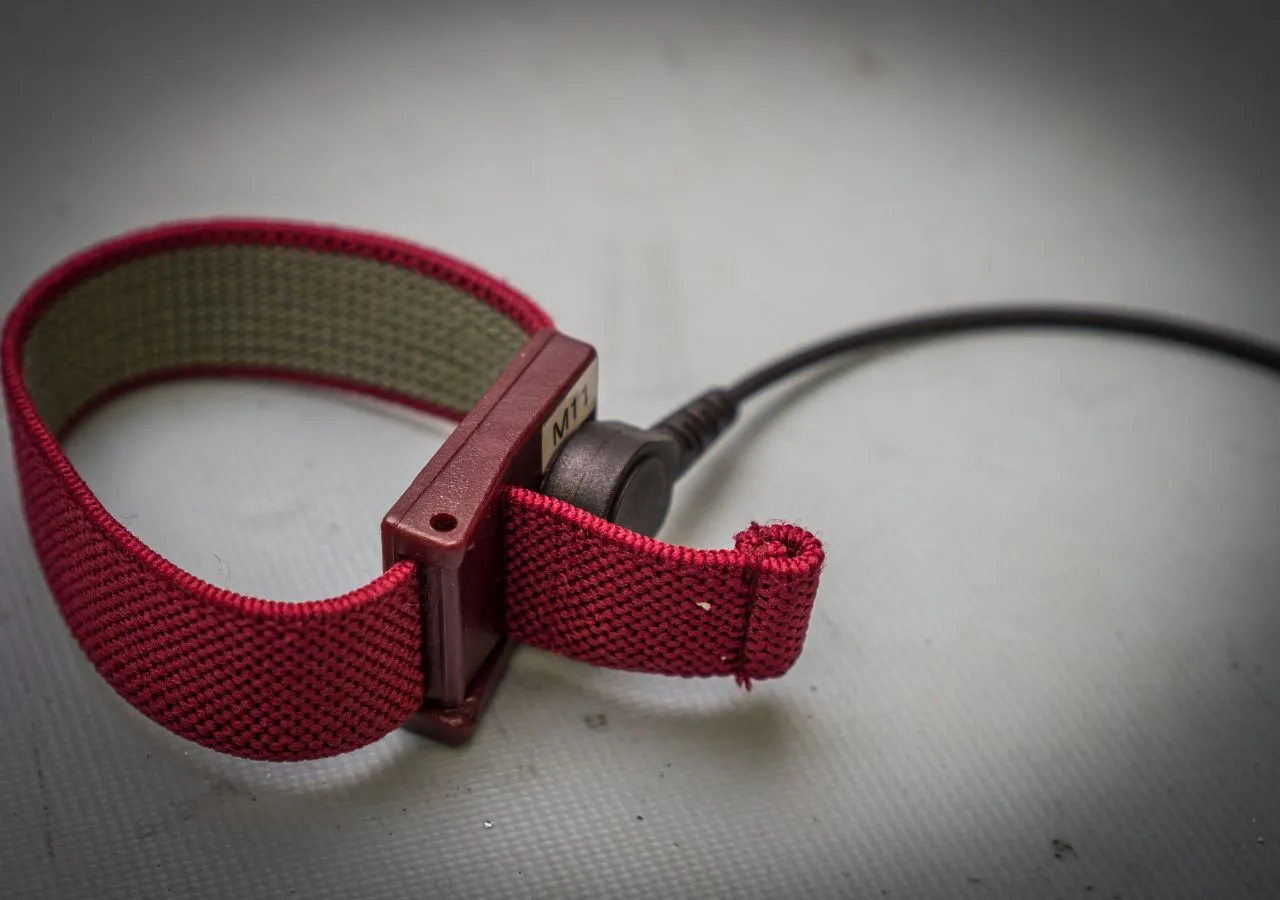
| Wrist Straps | Equalizing charge on personnel |
| Ionizers | Neutralizing charge on insulators |
| ESD Packaging | Safe handling and transportation |
| Humidity Control | Reducing static charge generation |
Poor ESD control can lead to:
- Immediate device failure
- Latent damage
- Yield reduction
- Increased warranty returns
Future Trends in ESD Engineering
The next stage of ESD engineering will likely involve:
- AI-assisted protection design
- Real-time transient monitoring
- Smart self-healing protection circuits
- Advanced simulation-based optimization
- Protection for sub-THz systems
- Quantum electronics ESD protection
- Bio-integrated electronics immunity
Future Research Areas
| Area | Importance |
|---|---|
| 3D IC ESD Modeling | Advanced packaging |
| Chiplet Protection | Heterogeneous integration |
| Wearable Medical EMC | Human interaction |
| AI-Optimized ESD Design | Autonomous design optimization |
| Quantum Electronics Protection | Protection for emerging technologies |
ESD engineering is becoming increasingly interdisciplinary, bringing together:
- Electromagnetics
- Semiconductor physics
- Circuit design
- Reliability engineering
- Biomedical engineering
- AI-assisted modeling
Frequently Asked Questions
What is electrostatic discharge (ESD) and why does it matter for modern electronics?
ESD occurs when electrical charge suddenly moves between two objects at different electrical potentials, and a single event can damage an integrated circuit, corrupt data, or create latent failures that only appear months after deployment. As semiconductor devices move toward smaller geometries and higher integration, electronic systems have become significantly more sensitive to these fast transient events.
What are the main updates introduced in EN 61000-4-2:2025?
The 2025 revision includes higher test voltages, improved waveform verification, updated coupling plane methodologies, better environmental conditioning guidance, clarified performance criteria, and expanded coverage for IoT and wearable devices. These changes better reflect the real-world conditions that modern electronic products face.
Why are advanced semiconductor technologies more vulnerable to ESD than older ones?
Modern technologies such as FinFET, GAA transistors, and 3D ICs have ultra-thin gate oxides, lower operating voltages, and smaller geometries that leave engineers with much narrower ESD design windows. Gate oxide breakdown voltages decrease as CMOS technologies continue to shrink, making protection design increasingly difficult.
What ESD challenges are specific to wearable medical devices?
Wearable medical systems rely on extremely weak bio-signals in the microvolt to millivolt range, making them highly susceptible to even small electromagnetic disturbances caused by ESD. Researchers have proposed advanced test systems using bio-equivalent phantoms and simulated signal generators to improve test repeatability for these safety-critical devices.
How does ESD affect automotive electronics?
Modern vehicles contain hundreds of electronic control units, high-speed communication buses, and AI-driven systems, all of which increase ESD exposure risks. Systems such as ADAS, battery management, radar, and EV charging are particularly vulnerable to sensor reliability issues, high-voltage transients, and RF front-end sensitivity.
What is the Charged Device Model (CDM) and why is it important today?
CDM represents the scenario where a device itself becomes charged and then discharges upon contact with ground, producing extremely fast rise times and peak currents above 7 A at 500 V. It is now considered one of the most critical ESD threats for advanced semiconductor technologies due to the high sensitivity of modern nodes.
What are the key ESD protection challenges for high-speed interfaces?
High-speed interfaces such as USB4, PCIe Gen6, and mmWave systems require protection devices with very low capacitance to preserve signal integrity, while still responding fast enough to clamp transient events. Designers increasingly rely on ultra-low capacitance TVS devices, distributed protection architectures, and electromagnetic simulation to meet these constraints.
Conclusion
Electrostatic discharge remains one of the most important reliability and EMC challenges in modern electronics.
As semiconductor technologies continue to scale and electronic systems become more interconnected, ESD protection has moved well beyond traditional manufacturing controls.
Today, ESD engineering intersects with:
- AI systems
- Wearable robotics
- Biomedical devices
- Automotive electronics
- Power electronics
- IoT ecosystems
- Advanced semiconductor technologies
- High-speed communication systems
Updates such as EN 61000-4-2:2025 show how regulatory frameworks are adapting to modern electronic products and real-world use conditions.
At the same time, research in wearable robotics, advanced CMOS protection, system-level immunity, and AI-driven electronics is reshaping the future of EMC and reliability engineering.
For engineers, manufacturers, testing laboratories, and product developers, understanding modern ESD challenges is no longer optional. It is essential for product reliability, compliance, safety, and long-term performance in the field.
References
- IEC 61000-4-2:2024 / EN 61000-4-2:2025.
- Chun-Yu Lin and Ming-Dou Ker, “ESD Protection Design: Fundamentals and Advanced Strategies,” IEEE Open Journal of the Solid-State Circuits Society, 2026.
- Jianqing Wang, “ESD Immunity Test System for Bio-Signal-Driven Wearable Robots,” IEEE EMC Magazine, 2024.
- Kevin Parmenter, “ESD Protection for Power Electronic ICs and Discrete Devices,” IEEE Power Electronics Magazine, 2024.
- JEDEC JESD22-A114 Human Body Model.
- JEDEC JESD22-C101 Charged Device Model.
- IEC 60601-1-2 Medical EMC Standard.
- IEC 61000-4-5 Surge Immunity Standard.
- Automotive Electronics Council (AEC) ESD Qualification Standards.
- CISPR and IEC TC77 EMC standardization activities.
At Stancer Testing-Lab, we help manufacturers address EMC and ESD challenges through practical testing, compliance support, reliability evaluation, and design troubleshooting. Our team supports ESD testing, EMC testing, RF testing, conducted emissions testing, radiated emissions testing, conducted immunity testing, radiated immunity testing, harmonic and flicker testing, and EMC pre-compliance testing for products preparing for CE marking and global market access.