
ISED Certification Testing for the Canadian Market
What Is ISED Certification?
Innovation, Science and Economic Development Canada (ISED) is the federal department responsible for managing Canada’s radio spectrum under the Radiocommunication Act. Category I radio equipment generally requires certification and listing on ISED’s Radio Equipment List (REL) before it can be imported or sold in Canada.
Certification involves three steps. First, an ISED-recognized test lab tests the product against the applicable Radio Standards Specifications (RSS) and prepares a report. Next, an ISED-recognized certification body—or ISED’s own Certification and Engineering Bureau—reviews the application and issues the certificate. Finally, the certified product is added to ISED’s Radio Equipment List (REL), where it must be listed before it can be sold.
Category II equipment does not require certification, but it must still meet the applicable technical and administrative requirements. Non-radio electronic products may be subject to the Interference-Causing Equipment Standards (ICES). For digital and IT equipment covered by ICES-003, compliance is self-declared: the manufacturer or importer arranges testing, retains the report and provides the required compliance marking.
Wireless products may also require ICES-003 host-emissions testing in addition to the applicable RSS requirements, depending on the functions of their digital circuitry.
Our ISED Testing and Canadian Equipment Compliance Process
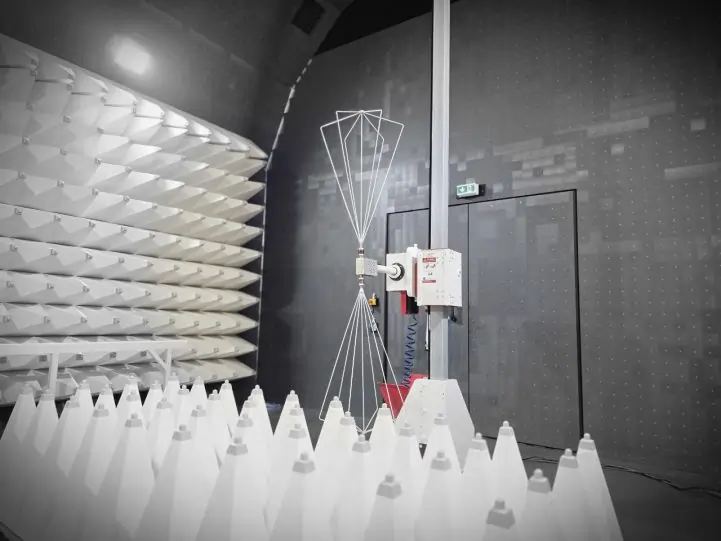
Stancer Testing-Lab provides ISED certification testing in Canada and Canadian product compliance support for wireless devices, electronic equipment and integrated radio systems. Our ISED testing services help manufacturers plan the radio and host-emissions assessments needed for the Canadian market. Our RF testing and EMC testing services help manufacturers establish the applicable Radio Standards Specifications (RSS) and Interference-Causing Equipment Standards (ICES), evaluate their products and prepare technical evidence for the appropriate compliance pathway.
From our laboratory in Laval, Quebec, Stancer offers RF testing capabilities up to 325 GHz for Canadian and U.S. compliance programs. The required frequency range, measurement method and product configuration are defined in the test plan. Discuss your product with our engineering team.
Does Your Product Require ISED Certification?
Innovation, Science and Economic Development Canada (ISED) establishes Canadian requirements for radio apparatus and interference-causing equipment. The route depends on the product’s functions and equipment category. Radio certification and ICES compliance are different obligations; a wireless product can require both.
| Equipment category | Typical requirements | Compliance pathway |
|---|---|---|
| Category I radio equipment | RSS-Gen and the applicable technology-specific RSS; RF exposure requirements where applicable | Testing, certification review and listing on ISED’s Radio Equipment List (REL) |
| Category II equipment | The applicable RSS or ICES standard, with its documentation and labeling requirements | Exempt from certification; technical compliance remains required |
| Electronic host with a radio module | Module approval conditions, host emissions and applicable RF exposure requirements | Product-specific review to establish whether module approval is sufficient and what additional work is required |
ISED Compliance Testing: RSS Radio & ICES Emissions
We define a test program around the radio architecture, operating bands, antenna configuration, intended use and target markets. This establishes representative operating modes and configurations before formal measurements begin.
Radio Performance and Spectrum Compliance
Applicable measurements can include RF output power, power spectral density, occupied bandwidth, band-edge emissions, unwanted emissions and frequency stability. Technology-specific requirements, including dynamic frequency selection where applicable, are identified during test planning.
ICES Emissions Testing for Electronic Equipment
We evaluate emissions from digital circuitry, power supplies, cables and enclosures against the applicable ICES requirements. ICES-003 testing addresses radio-frequency emissions from information technology equipment, including digital apparatus, where the product falls within that standard’s scope. A wireless product’s transmitter approval does not establish compliance of its host electronics.
Pre-Compliance and Engineering Support
EMC pre-compliance testing helps identify marginal emissions before the formal campaign. Engineering investigations can examine grounding, shielding, filtering and cable arrangements, followed by verification of the revised configuration.
High-Frequency and Radar Testing
Our RF capabilities extend up to 325 GHz. For radar and other high-frequency products, we establish the applicable operating-band and unwanted-emission measurements. See our automotive radar testing services for vehicular radar applications.
RSS and ICES Standards for Canadian Compliance
The following groups summarize RSS and ICES standards for Canadian radio and emissions testing. Applicability depends on the equipment, frequency band and intended use. We confirm the applicable edition, required methods and test configurations when preparing your program.
| Product or technology group | Applicable standards |
|---|---|
| General radio requirements | RSS-Gen |
| Licence-exempt and wireless networking equipment | RSS-210, RSS-213, RSS-247, RSS-248, RSS-310 |
| Land-mobile, cellular and broadband equipment | RSS-119, RSS-130, RSS-132, RSS-133, RSS-134, RSS-137, RSS-139, RSS-140; RSS-191 through RSS-199 |
| Receivers and aeronautical equipment | RSS-135, RSS-141, RSS-142, RSS-215 |
| Satellite and maritime equipment | RSS-170, RSS-181, RSS-182, RSS-238 |
| Radar and transportation radio systems | RSS-211, RSS-251, RSS-252 |
| Wireless power, UWB and white-space devices | RSS-216, RSS-220, RSS-222 |
| Citizens band, medical radio and distress systems | RSS-236, RSS-243, RSS-244, RSS-287, RSS-288 |
| Interference-causing equipment | ICES-Gen, ICES-001, ICES-002 C, ICES-003, ICES-005 |
We confirm the applicable standards and any method-specific limitations when preparing your test plan. RF exposure requirements are reviewed separately as part of product assessment.
The ISED Testing and Certification Process
- Assess the product: review radio functions, antennas, power supplies, modules and intended markets.
- Define the test plan: identify applicable standards, samples, operating modes and technical documents.
- Evaluate the design: perform optional pre-compliance work and the agreed formal measurements.
- Prepare the evidence: assemble reports and supporting product information.
- Complete the appropriate pathway: for Category I equipment, the application proceeds to an ISED-recognized certification body or ISED for review and certification, with REL listing required before Canadian market introduction.
Stancer provides testing and compliance support. Certification decisions are made by the authorized certification body or ISED.
Products Using Pre-Certified Radio Modules
A certified module can reduce the testing required for the finished product when it is integrated within its approval conditions. Our review considers the module certificate, antenna type and gain, RF settings, integration instructions and the host’s intended use. Changes to these conditions can trigger additional evaluation or certification work.
The finished product must still satisfy applicable host emissions and RF exposure requirements. Handheld and wearable hosts require particular attention under ISED’s host and modular approval rules. Provide the module’s certification number and integration instructions when requesting a test plan.
RF Exposure Requirements
RSS-102 establishes RF exposure requirements, including criteria for exemption from routine evaluation and applicable measurement or simulation routes. We help identify the required assessment based on frequency, output power, antenna gain, separation distance and simultaneous transmission. The project plan specifies any calculations, measurements, simulations or specialist testing needed.
Coordinated FCC and ISED Testing
For products entering Canada and the United States, we can coordinate FCC certification testing and equipment authorization support with the Canadian test program. Shared sample preparation and compatible measurement configurations can reduce duplicated work. Each country’s applicable limits, reports and authorization requirements are addressed separately; FCC authorization does not replace Canadian compliance.
ISED Labeling and Product Identification
Certified radio products require the applicable certification identification and product information under RSS-Gen and the relevant RSS. These include the ISED certification number, formed from the Company Number (CN) and Unique Product Number (UPN), and the Hardware Version Identification Number (HVIN). The Product Marketing Name (PMN), labels and documentation must correspond to the certified product.
Electronic labeling and host labeling for integrated modules are subject to specific conditions. Equipment covered by ICES requires its applicable compliance marking rather than a radio certification number alone. We review label artwork and required user notices as part of compliance preparation.
Preparing Your Product for Testing
Use our EMC & RF Client Information Sheet to organize the specifications and test configuration. Our Submission and Registration service supports certification-document preparation. Send the following information so we can define a practical ISED test program and quotation:
- Product function, intended use, dimensions and target markets.
- Radio technologies, frequency bands, channels and maximum RF output power.
- Antenna types, gains and installation arrangements.
- Existing module certificates and integration instructions, where applicable.
- Power source, connected cables, ports and accessories.
- Available samples, test firmware and instructions for controlling operating modes.
- Requested schedule and any previous test results.
Certification applications also require product documentation. Prepare the relevant schematics, block diagrams, operational description, photographs, user manual, label artwork and RF exposure information. Applicants outside Canada must identify a Canadian representative. Follow our checklist to prepare your wireless product for testing, including sample configurations, operating instructions, firmware and accessories.
ISED Certification: Frequently Asked Questions
Do all electronic products need ISED certification?
No. Category I radio equipment requires certification. Category II equipment is exempt from certification but remains subject to the relevant technical and administrative requirements.
How are the applicable RSS standards selected?
The product’s radio technology, frequency bands and intended operation determine the relevant Radio Standards Specifications. RSS-Gen provides general requirements, alongside the applicable technology-specific RSS. The test plan also addresses RF exposure requirements and host emissions where applicable. We confirm the required editions and configurations before testing.
What is the difference between RSS and ICES?
RSS documents address radio apparatus requirements. ICES documents address interference-causing equipment. An integrated wireless product can need both radio assessment and host emissions testing.
Does a certified module eliminate host testing?
Not automatically. Approval conditions, host emissions, RF exposure and product configuration determine the remaining requirements.
What determines ISED testing and certification cost?
ISED testing cost depends on the radio technologies, operating bands, antennas, configurations and measurements required for the product. Sample readiness, test firmware and documentation also affect the schedule. For Category I equipment, certification-body review and application work are additional parts of the authorization program. We prepare a quotation identifying the laboratory testing and application support included, with any troubleshooting or retesting agreed separately.
Can Stancer support both Canadian and U.S. testing?
Yes. We can plan the RSS, ICES and applicable FCC measurements together while addressing each market’s requirements separately.
Can Stancer test up to 325 GHz?
Yes. Our RF testing capabilities extend up to 325 GHz. The measurement range and methods needed for your product are established in its test plan.
Plan Your ISED Testing Program
Discuss your product, radio architecture and Canadian market requirements with Stancer’s engineering team.
Official ISED Resources
Plan your testing
Let’s move your product toward market.
Tell us about your product, testing needs, and target markets. Our technical team will help define the scope and prepare a tailored quotation.