
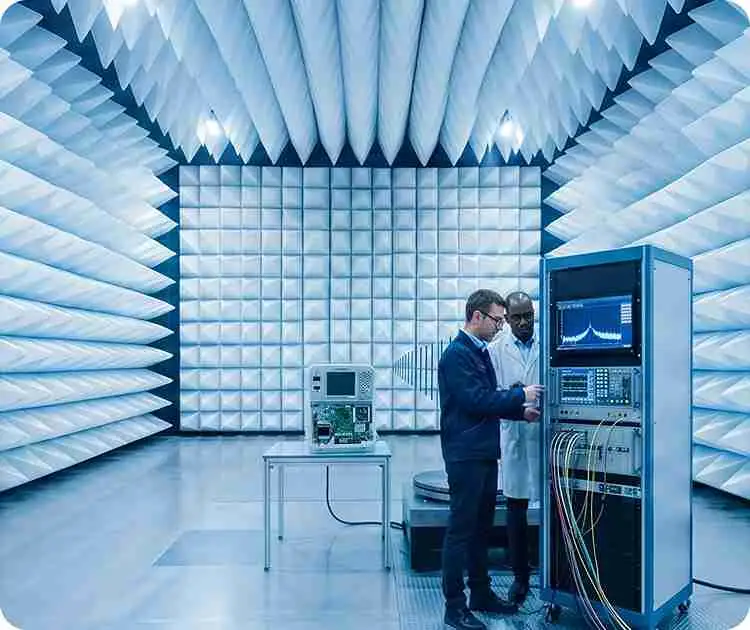
Conducted Emission Testing
Conducted Emission testing measures the unwanted electromagnetic noise that travels through power or signal cables, confirming that the device does not inject interference into the electrical supply/Grid or affect nearby equipment connected to the same power line.
Benefits of Conducted Emission Testing
- Ensures compliance with regulatory standards.
- Prevents interference with other electronic equipment connected to the same power lines.
- Improves product reliability and performance in real-world environments.
- Avoids unwanted noise propagation through AC/DC power lines and communication ports.
- Supports clean and stable operation in sensitive or high-density electronic environments.
- Minimizes field failures and return rates caused by EMC-related issues.
- Improves customer satisfaction and increases trust in product quality.
- Ensures compatibility with other system components, especially in complex assemblies (automotive, aerospace, medical).
We perform conducted emission testing for a frequency range from 9 kHz to 30 MHz and a current up to 200A, 3-phase suitable for a wide variety of products. This broad capability allows us to evaluate compliance for both commercial and specialized applications across global markets.
Our Process and Testing Capabilities
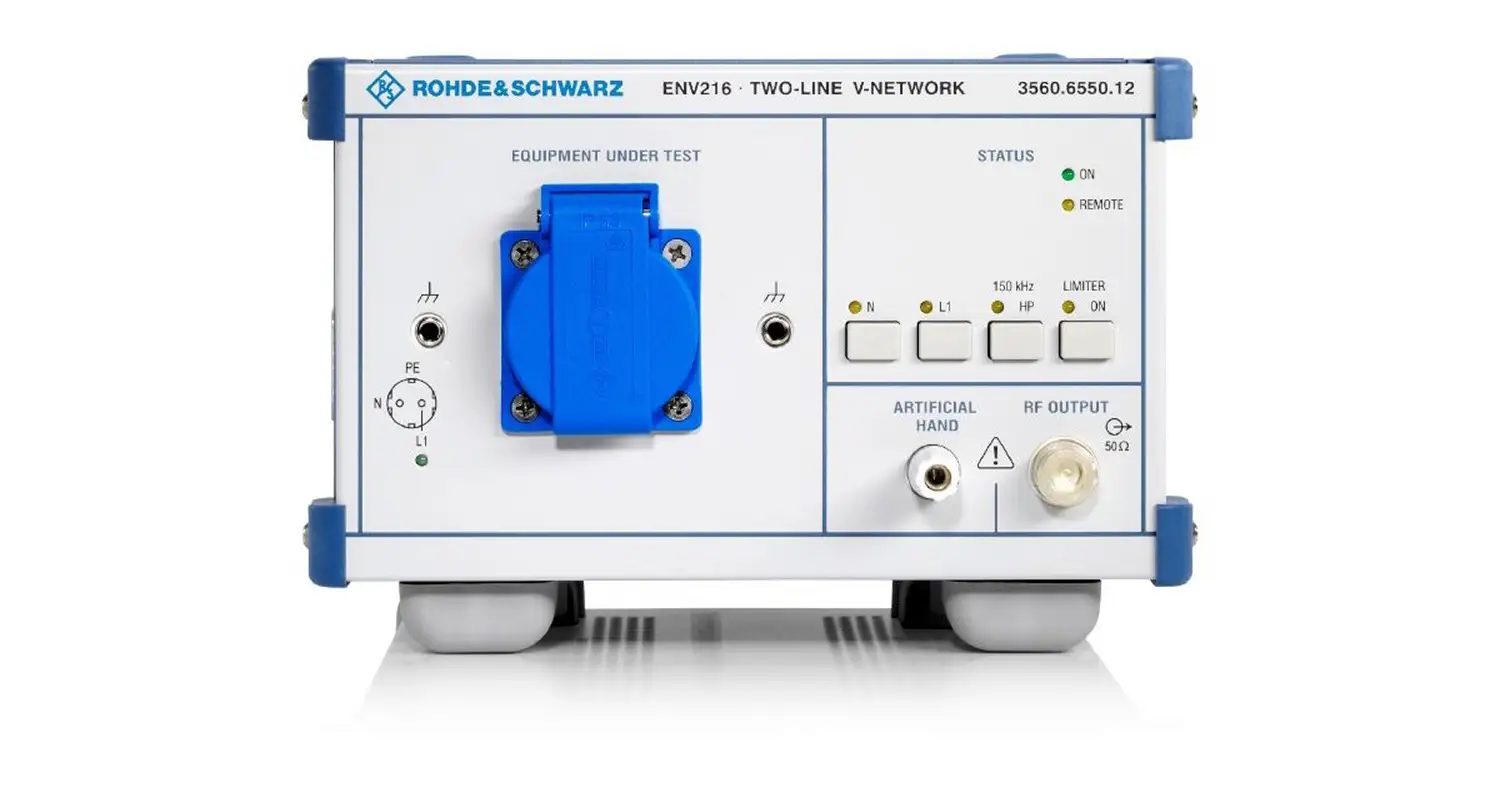
We take advantage of Line Impedance Stabilization Networks (LISNs), a 200 Amp power line filter with 100 dB attenuation, and a fully compliant programmable AC/DC power source to ensure a clean and stable measurement environment. This setup effectively isolates the test system from external disturbances and guarantees accurate, repeatable results, particularly when assessing mitigation techniques such as properly selected EMI filters. Our testing instruments provide Peak, Quasi-peak and average detector measurements for accurate conducted emissions testing and EMC compliance testing.
Our engineers methodically sweep the full frequency spectrum to locate the strongest emission points. A targeted maximization procedure is then carried out to validate the true peak values used for the final compliance measurement, ensuring reliable results for product compliance testing and electromagnetic compatibility (EMC) testing.
Our procedures fully comply with major international standards such as EN 55032 and FCC Part 15 Subpart B, ICES-003, CISPR 11 – ISM Equipment, CISPR 32 / EN 55032 – Multimedia Equipment, CISPR 22 / EN 55022 – ITE (Legacy), VCCI V-3 – Japan, KN 32 / KCC – Korea and UNECE Regulation No. 10 (R10). These standards apply to a wide range of industries, from automotive and aerospace to industrial control systems and communication devices, supporting global regulatory pathways including CE marking compliance, FCC certification, ISED certification, and international EMC regulatory compliance. For medical electrical equipment, conducted emissions are evaluated as part of EMC testing for medical devices in accordance with applicable IEC 60601-1-2 requirements.