

Automotive EMC Testing
Automotive EMC Testing Lab for Vehicles & Electronic Sub-Assemblies
Stancer Testing-Lab is an ISO/IEC 17025 accredited automotive EMC testing laboratory in Laval, Quebec, supporting complete vehicle testing as well as Electrical/Electronic Sub-Assembly (ESA) and automotive component testing. We work with vehicle manufacturers, OEMs, Tier 1 suppliers, and developers of automotive electronic systems to evaluate electromagnetic emissions, immunity, electrical transient performance, and vehicle electrical-load conditions.
Our automotive EMC capabilities support key international standards and regulatory requirements including UNECE Regulation No. 10 (R10), CISPR 12, CISPR 25, ISO 11451, ISO 11452, ISO 10605, ISO 7637-2, and ISO 16750-2. Depending on the product and target market, testing can address complete vehicles as well as ECUs, controllers, power electronics, sensors, communication modules, and other ESAs. For radar sensors, ADAS components, and high-frequency automotive systems, Stancer also provides 76–81 GHz automotive radar testing and ISO/IEC 17025 accredited RF measurement capabilities extending up to 325 GHz.
By combining vehicle-level and component-level automotive EMC testing with regulatory and technical support, Stancer helps OEMs and suppliers identify compliance issues earlier, reduce redesign risk, simplify test planning, and prepare the required test evidence for vehicle approval, component qualification, and global market access.
Automotive Vehicle-Level & Electrical/Electronic Sub-Assembly (ESA) Testing
Vehicle-Level Automotive EMC Testing
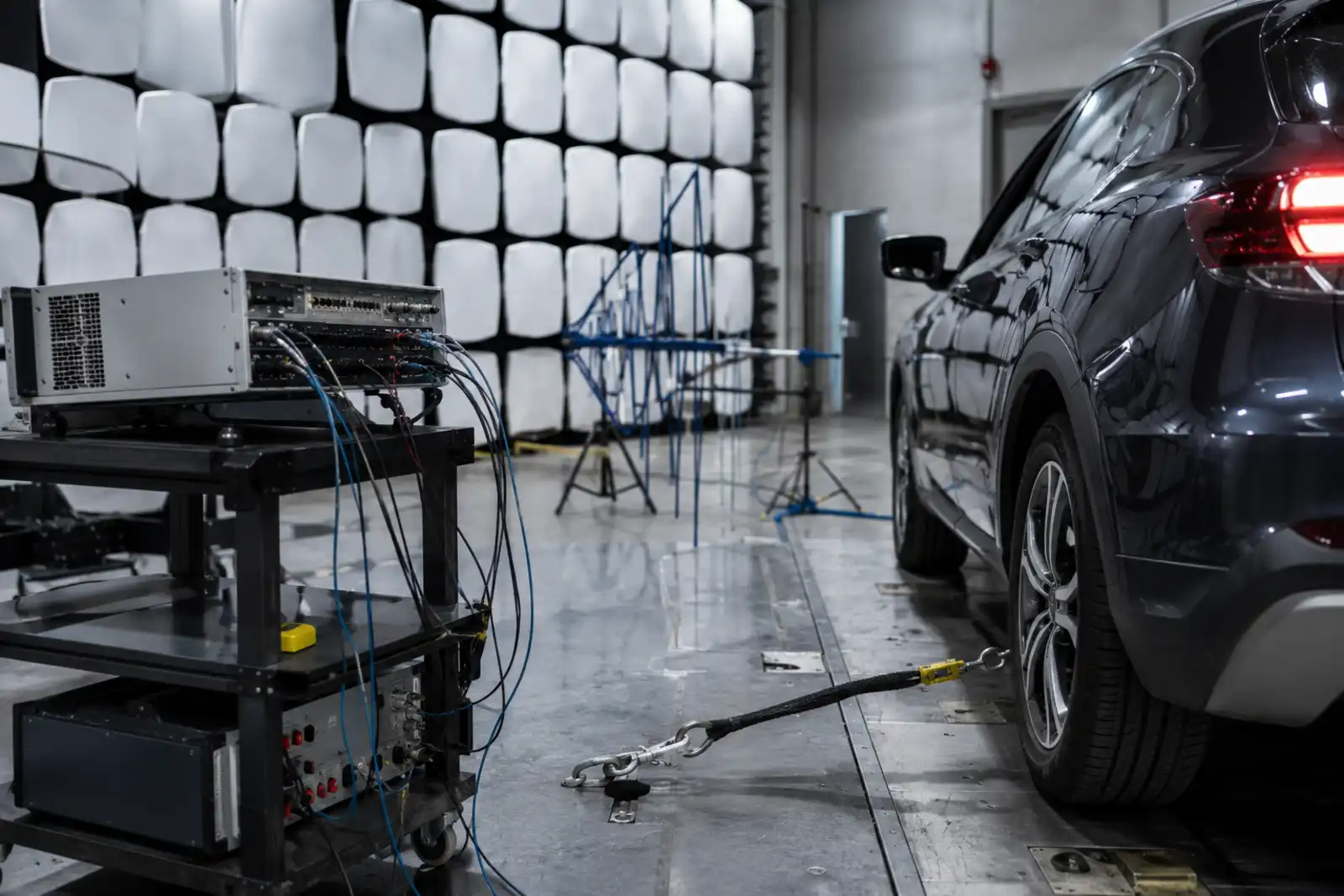
Stancer Testing-Lab provides vehicle-level automotive EMC testing for complete vehicles in a large semi-anechoic chamber suitable for small and medium-sized vehicles. Vehicle-level evaluation helps manufacturers verify electromagnetic compatibility after electronic modules, wiring harnesses, antennas, power electronics, communication systems, and other electrical subsystems have been integrated into the vehicle.
Depending on the vehicle, regulatory pathway, and test program, vehicle-level testing can include radiated emissions testing, radiated immunity testing, and other applicable evaluations supporting requirements such as UNECE Regulation No. 10 (R10), CISPR 12, and ISO 11451. Testing can be performed under representative operating conditions appropriate to the vehicle and applicable test plan.
ESA & Automotive Component EMC Testing
Stancer Testing-Lab provides EMC and electrical testing for automotive Electrical/Electronic Sub-Assemblies (ESAs), including electronic control units (ECUs), sensors, power electronic converters, communication modules, lighting systems, and other vehicle electronics.
| Electromagnetic emissions | conducted emissions testing and radiated emissions that may interfere with vehicle electronics or the surrounding electromagnetic environment. |
| Electromagnetic immunity | Evaluation of correct operation when automotive electronics are exposed to electromagnetic disturbances. |
| automotive transient testing | Transient pulses, supply variations, starting conditions, interruptions, and applicable load-dump events. |
| Vehicle & component compliance | Support for OEM, Tier 1, qualification, regulatory, and market-access requirements. |
UNECE Regulation No. 10 (R10) Automotive EMC Testing
UNECE Regulation No. 10 establishes electromagnetic compatibility requirements for complete vehicles and Electrical/Electronic Sub-Assemblies (ESAs) intended for installation in vehicles. Stancer Testing-Lab supports automotive manufacturers, OEMs, and Tier 1 suppliers with testing and technical documentation for applicable UNECE R10 requirements.
| Test Level | Typical Evaluation | Typical Application |
|---|---|---|
| Vehicle Level | Vehicle-level electromagnetic emissions and immunity testing under representative operating conditions. | Complete vehicles and applicable vehicle configurations. |
| ESA / Component | Conducted and radiated emissions, electromagnetic immunity, and applicable electrical transient evaluations. | ECUs, sensors, converters, communication modules, lighting electronics, power electronics, and other ESAs. |
Related automotive standards commonly used alongside UNECE R10 include CISPR 12, CISPR 25, ISO 7637-2, ISO 11451, ISO 11452, and ISO 10605.
Vehicle-Level & Component-Level Automotive EMC Standards
Automotive EMC programs use different test methods depending on whether evaluation is performed on the complete vehicle or on an Electrical/Electronic Sub-Assembly.
| Standard | Test Level | Primary Application |
|---|---|---|
| CISPR 12 | Vehicle | Vehicle-level radio-disturbance emissions for protection of off-board receivers. |
| CISPR 25 | Vehicle / Component | Electromagnetic disturbances affecting receivers installed on-board the vehicle. |
| ISO 11451 | Vehicle | Vehicle-level immunity to radiated electromagnetic disturbances. |
| ISO 11452 | ESA / Component | Component-level electromagnetic immunity for ECUs and other Electrical/Electronic Sub-Assemblies. |
| ISO 7637-2 | ESA / Component | Electrical transient disturbances conducted along vehicle supply lines. |
| ISO 10605 | Vehicle / Component | ESD testing for automotive electronic systems and applicable vehicle configurations. |
| ISO 16750-2 | ESA / Component | Automotive electrical loads and vehicle power-supply conditions. |
ISO 16750-2 Automotive Electrical Load Testing
Stancer Testing-Lab performs automotive electrical load testing according to applicable ISO 16750-2 requirements for electrical and electronic equipment installed in road vehicles. ISO 16750-2 addresses electrical loads and complements automotive EMC testing by evaluating equipment behavior under representative vehicle power-supply conditions.
| Overvoltage & undervoltage | Operation outside nominal vehicle supply-voltage conditions. |
| Voltage drops & short interruptions | Functional behavior during temporary supply disturbances. |
| Supply-voltage variations | Performance under changing vehicle electrical-system conditions. |
| Starting & cranking profiles | Evaluation during engine starting and applicable low-voltage conditions. |
| Reset behavior | Correct recovery following supply interruptions or voltage disturbances. |
| Superimposed AC voltage | Response to AC ripple superimposed on the DC vehicle supply. |
| Load-dump conditions | Response to applicable high-energy overvoltage events. |
Applicable test methods, voltage levels, durations, and severity levels are selected according to the equipment, vehicle electrical architecture, OEM requirements, and relevant edition of ISO 16750-2.
Testing Capabilities
| Test / Capability | Applicable Standard |
|---|---|
| Radiated emissions | CISPR 12 / CISPR 25 |
| UNECE R10 vehicle & ESA compliance | UNECE Regulation No. 10 (R10) |
| Electrical transient immunity | ISO 7637-2 |
| Open-circuit and short-circuit testing | ISO 16750-2 |
| Load-dump testing | ISO 16750-2 |
| Starting profile testing | ISO 16750-2 |
| Supply-voltage variations | ISO 16750-2 |
| Vehicle-level radiated immunity | ISO 11451 |
| Component / ESA radiated immunity | ISO 11452 |
| Electrostatic discharge (ESD) immunity | ISO 10605 |
Questions About Automotive EMC Testing
Stancer provides comprehensive automotive EMC testing for Canadian and U.S. vehicle manufacturers, OEMs, Tier-1 suppliers, and automotive technology companies. Our extensive testing capabilities, modern laboratory equipment, broad accreditation scope, flexible scheduling, and PhD-level EMC expertise allow manufacturers to consolidate complex automotive EMC programs with a single laboratory.
What automotive EMC testing capabilities does Stancer offer?

Stancer provides a comprehensive suite of automotive EMC testing for complete vehicles, electrical/electronic sub-assemblies (ESAs), and automotive components. Capabilities include radiated and conducted emissions, radiated and conducted immunity, electrostatic discharge (ESD), electrical transient testing, supply-voltage disturbances, and other applicable automotive EMC evaluations. Testing is supported by modern EMC instrumentation and facilities designed to help manufacturers consolidate multiple compliance requirements within a single laboratory.
What automotive EMC standards can Stancer test to?
Can Stancer perform UNECE R10 testing for complete vehicles and electronic sub-assemblies (ESAs)?
Does Stancer provide CISPR 25 testing for OEMs and Tier-1 automotive suppliers?
Can Stancer perform automotive immunity testing such as ISO 11452?
Can Stancer perform automotive transient, load-dump, voltage disturbance, and ESD testing?
Can Canadian and U.S. automotive manufacturers use Stancer for their EMC certification and qualification programs?
Why choose Stancer as an automotive EMC testing lab?
Can Stancer handle a complete automotive EMC test program instead of using multiple laboratories?
Does Stancer offer automotive EMC pre-compliance and troubleshooting before formal testing?