
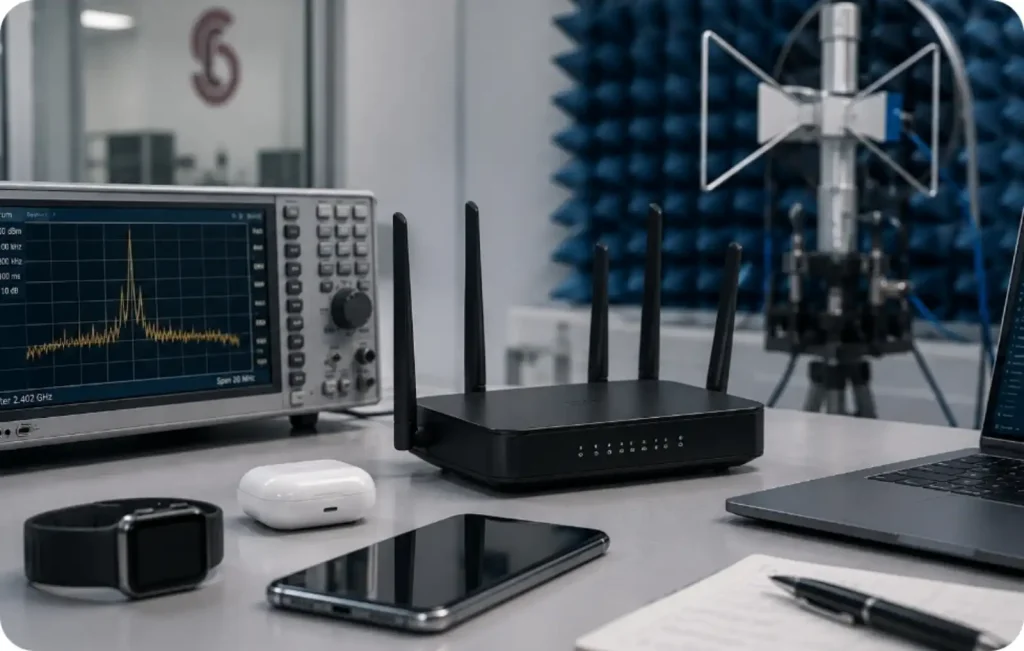
FCC Certification Testing for U.S. Market Access
What Is FCC Certification?
FCC certification is a U.S. equipment authorization process administered by the Federal Communications Commission for devices that require certification. It helps ensure that products meet applicable radiofrequency requirements and do not cause harmful interference with communications services or other equipment.
Key Product Categories Subject to FCC Requirements
- Intentional radiators: Devices designed to transmit radio signals, such as Wi-Fi routers, Bluetooth devices, smartphones, and garage door openers.
- Unintentional radiators: Electronic products that generate radiofrequency energy during normal operation, including digital displays, computers, and certain power adapters. These products may qualify for the Supplier’s Declaration of Conformity (SDoC) procedure.
- Industrial, scientific, and medical equipment: Equipment that generates and uses RF energy for industrial, scientific, or medical purposes, subject to FCC Part 18 requirements.
Our FCC Testing and U.S. Equipment Authorization Process
Stancer Testing-Lab is an FCC testing lab in Canada providing FCC certification testing and equipment authorization support for manufacturers entering the United States. We evaluate electronic products, wireless devices and licensed radio systems against the applicable FCC requirements. Our EMC testing and RF testing services help manufacturers establish the applicable FCC rules, evaluate representative product configurations and prepare technical reports.
Our FCC testing services cover unintentional radiators, licence-exempt transmitters, licensed radio equipment and specialist applications, with RF measurement capabilities extending up to 325 GHz. The required measurement range and methods are determined for each product.
From planning to application preparation, we help you establish the appropriate authorization pathway. Our Submission and Registration service supports preparation and coordination of certification documentation.
Certification or SDoC: Which Route Applies?
The required FCC equipment authorization procedure depends on the product and the applicable rule part. Many digital devices follow Supplier’s Declaration of Conformity (SDoC), while most intentional transmitters require Certification. A product with multiple functions can have more than one authorization obligation.
| Pathway | Typical application | Required outcome |
|---|---|---|
| Supplier’s Declaration of Conformity | Many Part 15 Subpart B digital devices and applicable Part 18 equipment | The U.S.-based responsible party ensures compliance, retains the required evidence and supplies compliance information. No FCC certification grant is issued under SDoC. |
| Certification | Most intentional transmitters and other equipment for which the rules specify certification | Application and test evidence reviewed by an authorized Telecommunication Certification Body (TCB), leading to a grant and FCC ID |
| Integrated products | Digital hosts incorporating radio functions or certified modules | Review of each function and applicable host, transmitter and RF exposure requirements |
Class A and Class B Digital Devices
Part 15 Subpart B distinguishes Class A and Class B digital devices. Class B applies to equipment marketed for residential use and generally has more stringent emission limits. Product classification is established from the intended application and marketing conditions. Our FCC Part 15 testing page provides further information on digital and wireless equipment.
FCC Compliance Testing: Part 15, RF & EMC Services
We define a program around the equipment functions, bands, antennas, power supply and intended operating configurations. The test plan identifies the required measurements, relevant channels and modes, sample preparation and supporting documentation.
FCC Part 15 Subpart B Testing: Digital Equipment & Hosts
Conducted and radiated emissions testing supports Part 15 Subpart B compliance for applicable digital devices and wireless hosts. Measurements address representative cables, ports, peripherals and power configurations.
FCC Part 15 Subparts C & E: Wireless Transmitters
Technology-specific measurements can include output power, power spectral density, bandwidth, band-edge emissions, spurious emissions and frequency stability. Part 15 Subpart E programs address DFS requirements where applicable.
Licensed Radios and Specialist Equipment
Our testing services cover commercial mobile, land-mobile, CBRS, satellite, maritime, aviation and broadcast radio testing, as well as signal boosters and ISM equipment. The rule part and measurement method are selected for the product’s actual operating service.
High-Frequency Testing and Design Support
Stancer’s RF capabilities extend up to 325 GHz. We support automotive radar testing and other high-frequency applications. Optional EMC pre-compliance testing helps identify emissions problems before the formal campaign.
FCC Rule Parts and Measurement Methods
The following table summarizes FCC rule parts and measurement methods for the equipment categories we test. The required measurement range and applicable procedures are determined for each product.
| Equipment or technology | FCC rule part | Listed measurement method |
|---|---|---|
| Unintentional radiators | Part 15, Subpart B | ANSI C63.4:2014 |
| Industrial, scientific and medical equipment | Part 18 | FCC MP-5:1986 |
| Licence-exempt intentional radiators | Part 15, Subpart C | ANSI C63.10:2020 + Cor. 1:2023 |
| Unlicensed personal communications systems | Part 15, Subpart D | ANSI C63.17:2013 |
| U-NII devices without DFS | Part 15, Subpart E | ANSI C63.10:2020 + Cor. 1:2023 |
| U-NII devices with DFS | Part 15, Subpart E | FCC KDB 905462 D02 (v02), April 8, 2016; ANSI C63.10:2020 + Cor. 1:2023 |
| Ultra-wideband devices | Part 15, Subpart F | ANSI C63.10:2020 + Cor. 1:2023 |
| White-space devices | Part 15, Subpart H | ANSI C63.10:2020 + Cor. 1:2023 |
| Commercial mobile services | Parts 22 (cellular), 24, 25 (below 3 GHz) and 27 | ANSI/TIA-603-E; ANSI/TIA-102.CAAA-E; ANSI C63.26:2015 |
| General mobile radio services | Parts 22 (non-cellular), 90, 95, 97 and 101 (below 3 GHz for the latter four entries) | ANSI/TIA-603-E; ANSI/TIA-102.CAAA-E; ANSI C63.26:2015 |
| Citizens Broadband Radio Service | Part 96 | ANSI/TIA-603-E; ANSI/TIA-102.CAAA-E; ANSI C63.26:2015 |
| Maritime and aviation radio services | Parts 80 and 87 | ANSI/TIA-603-E; ANSI C63.26:2015 |
| Microwave and millimeter-wave radio services | Parts 25, 30, 74, 90, 95, 97 and 101 (above 3 GHz for Parts 90, 95, 97 and 101) | ANSI/TIA-603-E; ANSI/TIA-102.CAAA-E; ANSI C63.26:2015 |
| Broadcast radio services | Parts 73 and 74 (below 3 GHz) | ANSI/TIA-603-E; ANSI/TIA-102.CAAA-E; ANSI C63.26:2015 |
| Signal boosters | Part 20 and Section 90.219 | ANSI C63.26:2015 |
Additional Radio Measurement Methods
Additional radio measurement methods include ANSI C63.10:2013; ANSI C63.10:2020 + Cor. 1:2023 + C63.10a-2024 and its errata; ANSI C63.17:2013; ANSI C63.26:2015; ANSI/TIA-603-D and E; TIA-102.CAAA-D and E; WINNF-TS-0122; RTTE01; and CBRSA-TS-9001.
We confirm the FCC-accepted procedure and edition applicable to your program, including relevant Knowledge Database (KDB) guidance.
The FCC Testing and Authorization Process
- Review the product: establish the applicable rules, authorization route, markets and radio integration conditions.
- Prepare the test program: agree samples, test modes, configurations and documentation.
- Evaluate the design: perform optional pre-compliance investigations and formal testing.
- Prepare reports and exhibits: document results and assemble the technical evidence required for the selected route.
- Complete authorization preparation: for certification, support the TCB application and grant review; for SDoC, support the responsible party’s compliance documentation.
- Review production information: confirm required identifiers, labels, user notices and installation instructions.
Stancer provides testing and application support. The authorized TCB makes the certification decision and issues the grant. Our Submission and Registration service explains the supporting application workflow.
Products Using Pre-Certified Radio Modules
An FCC-certified module can reduce repeated transmitter testing when the integration complies with its grant conditions and instructions. We review the FCC ID, antennas, RF settings, installation constraints and intended use, including simultaneous transmission and RF exposure conditions.
The host must still meet its applicable requirements. Changes to antennas, power, RF firmware or installation conditions can require additional assessment or authorization work. The test plan considers the FCC’s KDB 996369 module integration guidance and the finished product’s digital emissions.
RF Exposure Assessment Planning
RF exposure requirements depend on the transmitter, frequency, power, antenna and intended distance from users or bystanders. We identify the applicable assessment route and documentation during planning. Any necessary SAR, power-density or other specialist measurements are specified separately.
FCC IDs, Labeling and Compliance Information
Certified equipment is associated with an FCC ID consisting of an FCC-assigned grantee code and the applicant’s product code. Labeling, electronic labeling where permitted, and user instructions must meet the applicable requirements. Module hosts require the appropriate identification when the installed module’s FCC ID is not visible.
SDoC equipment has its own product identification and compliance information requirements. An FCC logo does not replace the required information, and SDoC does not create an FCC certification grant. We review the documentation requirements for the product’s authorization route.
Preparing Your Product and Certification Documents
Use our EMC & RF Client Information Sheet to organize the product specifications and test configuration. For an FCC test plan and quotation, provide:
- Product function, dimensions, intended environment and target markets.
- Radio technologies, frequency bands, channels and maximum output power.
- Antenna types, gains and installation arrangements.
- Existing FCC IDs and module integration instructions.
- Power supplies, ports, connected cables and accessories.
- Available samples, test firmware and instructions for controlling operating modes.
- Required schedule and previous test results.
A certification application typically needs test reports, schematics, block diagrams, operational descriptions, photographs, label artwork, user instructions and applicable RF exposure evidence. Applicant information includes relevant registrations and declarations, and a designated U.S. agent for service of process. The U.S.-based SDoC responsible party and the certification applicant’s service-of-process agent fulfill different roles.
See FCC and ISED Submission and Registration for application preparation support.
Coordinated FCC and ISED Testing
For products entering Canada and the United States, we can coordinate the FCC program with ISED certification testing and ICES compliance. Compatible setups and sample preparation can reduce duplicated work. The technical requirements and authorization route for each market remain separate.
FCC Certification: Frequently Asked Questions
What does FCC Part 15 testing measure?
FCC Part 15 testing evaluates the requirements applicable to the product’s digital and radio functions. Subpart B addresses emissions from unintentional radiators such as digital equipment. Subparts C and E include requirements for applicable intentional transmitters, with measurements selected for the radio technology and operating band. We review the complete product to identify the relevant tests and authorization route.
Does every electronic product require FCC certification?
No. The route depends on the equipment and applicable rules. Many digital devices follow SDoC; most intentional transmitters require certification. Product-specific exemptions must be assessed.
Does a certified module eliminate host testing?
Not automatically. The module grant, integration conditions, host emissions and RF exposure requirements determine the remaining work.
Is FCC authorization sufficient for Canada?
No. Canadian requirements must be addressed separately. Stancer can coordinate the FCC and ISED testing programs.
Can Stancer test up to 325 GHz?
Yes. Stancer’s RF measurement capabilities extend up to 325 GHz. Your test plan establishes the range needed for the product.
What determines FCC testing and certification cost?
FCC testing cost depends on the radio technologies, frequency bands, antenna configurations, operating modes and measurements required for the product. Certification programs also involve application preparation and TCB review; these should be distinguished from laboratory testing when comparing quotations. Sample readiness, test firmware, documentation and any troubleshooting or retesting affect the schedule. Send your product specifications for a quotation identifying the testing and application support included.
Who issues the FCC certification grant?
An authorized TCB reviews the application and issues the grant. Stancer supports testing, reports and application preparation.
Plan Your FCC Testing Program
Discuss your product and U.S. market requirements with Stancer’s engineering team.
Request an FCC testing quotation
Already preparing your filing? Review our Submission and Registration service.
Official FCC Resources
Plan your testing
Let’s move your product toward market.
Tell us about your product, testing needs, and target markets. Our technical team will help define the scope and prepare a tailored quotation.