Temperature Exposure
Evaluate a sample at defined cold or hot conditions. Agree stabilization, exposure duration, powered or unpowered operation and the checks to perform.

Temperature and humidity testing exposes a product to controlled environmental conditions so engineers can assess its response before release, after a design change or against a defined qualification profile. Stancer Testing-Lab helps you plan temperature exposure, thermal cycling and humidity evaluations around the product, its intended use and the functions that matter.
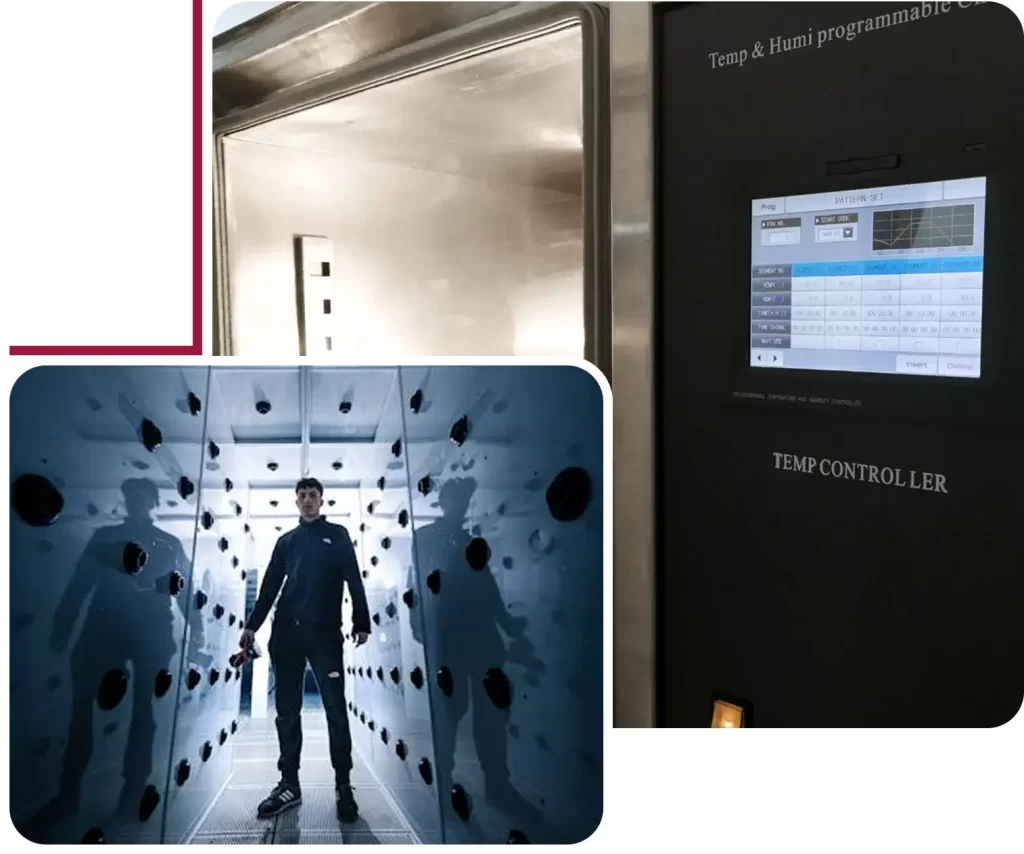
Our published chamber temperature capability extends from −40°C to +180°C. Available humidity conditions, ramp rates and sample loading are confirmed for your test profile. Combine environmental evaluation with a separate EMC testing program when both are required.
Discuss Your Test ProfileStart with the intended operating and storage conditions, then define the exposure and the response to measure.
Evaluate a sample at defined cold or hot conditions. Agree stabilization, exposure duration, powered or unpowered operation and the checks to perform.
Apply an agreed sequence of temperature changes and dwell periods. Compare functional behaviour and inspect the sample for changes after the specified cycles.
Evaluate the product under a specified temperature and relative-humidity combination. Confirm the chamber operating envelope, exposure duration and any condensation requirements before scheduling.
Temperature setpoints, humidity conditions, ramp rates and sample behaviour answer different questions. Agree the profile and assessment criteria before the sample enters the chamber.
Send the product dimensions, mass, heat dissipation and power requirements, together with the temperature and humidity profile. We review sample fit, loading, connections, monitoring and the conditions the chamber can maintain.
Thermal cycling is not automatically equivalent to thermal shock. Accelerated exposure also does not establish a service life without a justified model and correlation to the relevant failure mechanisms.
The test plan defines whether observations are made during exposure, after recovery or at both stages. Report requirements and any deviations are agreed for the project.
Use our client information sheet for product and supply details, and attach the environmental test profile when you contact the laboratory.
Coordinate the required evaluations while keeping each method, test condition and accreditation claim specific to the project.
A product may need both environmental evaluation and emissions, immunity or radio measurements. We help plan the separate test programs and representative configurations.
Stancer holds ISO/IEC 17025 accreditation for methods in its EMC and RF scope. Environmental testing coverage must be confirmed separately for the requested method and edition; EMC/RF accreditation alone does not establish environmental coverage.
Share the intended markets, product requirements and customer specifications so the test plan supports the documentation you need.
Agree the functions, configurations and acceptance criteria relevant to your equipment. Automotive and medical EMC programs remain separate evaluations against their applicable requirements.
It evaluates a sample’s response to an agreed environmental exposure. The plan identifies the temperature, humidity where applicable, duration, operating conditions and observations needed to assess the product.
Humidity control has its own operating envelope. Available temperature and relative-humidity combinations depend on the chamber and loading; the published temperature extremes do not imply 0–100% RH at every temperature.
Accelerated exposure can help investigate degradation or compare designs. Converting exposure into a predicted service life requires a justified acceleration model and correlation to the relevant failure mechanism.
Accreditation applies to the methods and conditions listed in the laboratory’s current scope. Review our accreditation information and confirm environmental coverage separately before specifying an accredited report.