
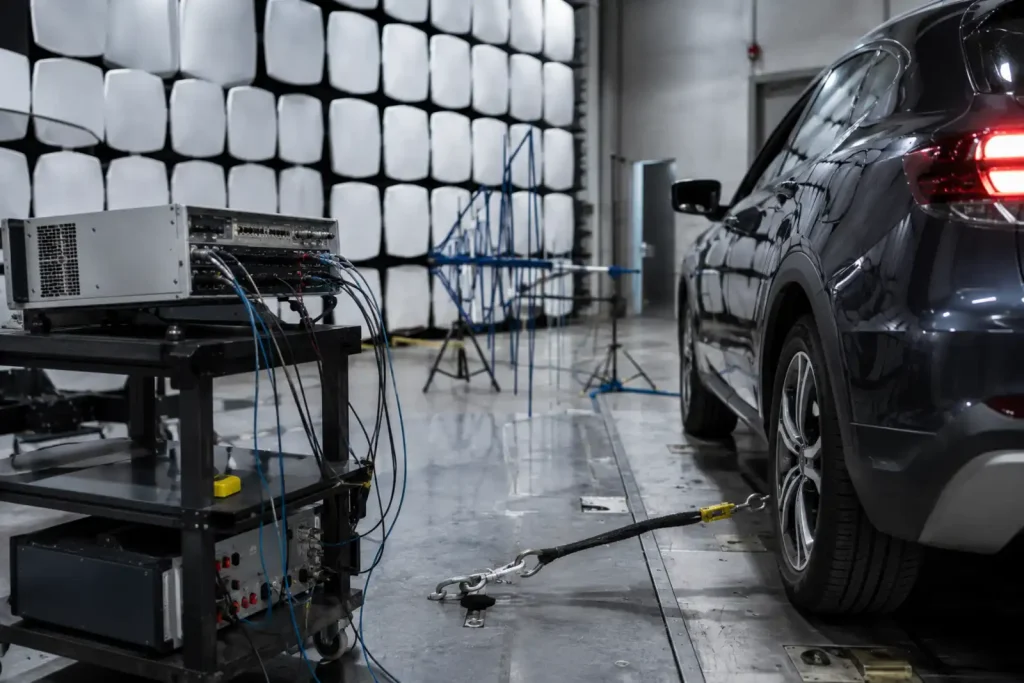
Automotive Radar & ADAS RF Testing up to 325 GHz
Stancer Testing-Lab provides automotive radar RF testing in Canada for manufacturers developing radar sensors, ADAS components and millimeter-wave devices for Canadian and U.S. markets. We evaluate the radio characteristics of the product and help prepare technical evidence for its applicable regulatory program.
Our high-frequency RF capability extends up to 325 GHz. The accredited methods, frequency coverage and configurations applicable to your device are confirmed against the current scope before testing. A laboratory's maximum frequency capability does not mean every measurement or product approval is covered across the entire range.
Testing can support 76–81 GHz automotive radar, commonly referred to as 77 GHz radar, together with applicable FCC and ISED regulatory requirements. Depending on the product, Stancer can combine radar and RF evaluation with Automotive EMC Testing, RF Testing, and pre-compliance engineering within a coordinated test program.
A2LA-accredited laboratory: ISO/IEC 17025:2017, certificate 7352.01. Review our accreditation and testing scope and laboratory capabilities. Your quotation identifies the agreed RF measurements, configurations and reporting requirements.
76–81 GHz Automotive Radar Testing
The 76–81 GHz frequency band is widely used for modern automotive radar systems supporting vehicle safety, sensing, object detection, and advanced driver-assistance functions. Stancer supports automotive radar sensor testing, including 77 GHz radar testing of radar modules, ADAS radar components, and integrated automotive systems operating across the 76–81 GHz frequency range.
- 76–81 GHz automotive radar systems
- 77 GHz automotive radar modules and sensors
- ADAS radar components
- Short-, medium-, and long-range radar applications
- Radar transmitters with integrated or external antennas
- Component, module, and final-product RF evaluation
- FCC regulatory testing for applicable U.S. requirements
- ISED regulatory testing for applicable Canadian requirements
- Pre-compliance and formal compliance measurements
Automotive Radar & ADAS Applications
ADAS radar testing is increasingly important as radar technology becomes integrated into safety-critical, assisted-driving, and automated vehicle functions. Stancer's high-frequency capabilities support radar and sensing technologies used in applications including:
- Adaptive cruise control
- Forward collision warning and collision avoidance
- Blind-spot detection
- Lane-change assistance
- Rear and cross-traffic detection
- Parking and proximity sensing
- Object and pedestrian detection
- Other radar-based ADAS and vehicle-safety functions
Automotive Radar RF Measurements
Stancer Testing-Lab's ISO/IEC 17025 accredited RF capabilities extend up to 325 GHz. Depending on the device, operating frequency, applicable standard, antenna configuration, and regulatory requirements, measurements can include:
- Transmitter output power
- Effective radiated power / EIRP
- Occupied bandwidth
- Emission bandwidth
- Power spectral density
- Frequency accuracy and stability
- Band-edge emissions
- Out-of-band emissions
- Spurious and harmonic emissions
- Unwanted emissions
- Radiated RF measurements
- Spectrum characterization
Automotive Radar Regulatory Standards
FCC Part 95 Subpart M: 76–81 GHz Radar
Automotive radar systems intended for the United States must comply with applicable FCC Part 95 Subpart M requirements for radar operating in the 76–81 GHz frequency band. Stancer supports applicable transmitter, bandwidth, unwanted-emission, and other required RF measurements as part of the FCC equipment authorization process. For broader U.S. radio-device testing, see our FCC Certification and RF Testing capabilities.
ISED RSS-251 — 76–81 GHz Vehicular Radar
ISED RSS-251 specifies certification requirements for licence-exempt vehicular radar operating in the 76–81 GHz frequency band in Canada. Testing is performed together with the applicable general requirements of RSS-Gen. Stancer supports Canadian RF compliance testing for automotive radar and other applicable radio devices. Additional information is available on our ISED Certification page.
Millimeter-Wave Testing up to 325 GHz
Automotive and sensing technologies continue to move toward increasingly high operating frequencies. Stancer Testing-Lab provides ISO/IEC 17025 accredited RF testing capabilities extending up to 325 GHz, enabling evaluation of conventional automotive radar as well as emerging millimeter-wave and high-frequency technologies.
This capability can support automotive radar, high-frequency sensors, short-range sensing systems, millimeter-wave transmitters and receivers, and other advanced RF technologies requiring measurements beyond conventional wireless frequency ranges.
Supporting Automotive EMC Services
Automotive radar and ADAS components frequently require more than RF transmitter measurements alone. Depending on the product and qualification program, Stancer can support manufacturers with Automotive EMC Testing, radiated emissions testing, conducted emissions testing, radiated immunity testing, conducted immunity testing, ESD testing, electrical transient testing, and pre-compliance evaluation.
Depending on the product and qualification plan, related automotive EMC requirements can include UNECE Regulation No. 10, CISPR 12, CISPR 25, ISO 11451, ISO 11452, ISO 7637-2 and ISO 16750-2. We confirm the applicable methods and coverage against the current accredited scope; electrical-load tests are distinct from the complete environmental qualification of a product. Any ISO 10605 requirement is reviewed separately before inclusion in the quotation.
RF transmitter compliance and EMC qualification address different questions. The agreed program should identify the operating modes, supply conditions, interfaces and performance criteria for each assessment.
Who We Support
- Automotive OEMs
- Tier-1 and Tier-2 suppliers
- Radar sensor manufacturers
- ADAS technology developers
- RF module and semiconductor manufacturers
- Vehicle electronics manufacturers
- Research and development teams
Prepare Your Radar Sensor for Testing
Use our EMC & RF Client Information Sheet to describe the product and intended markets. For the associated EMC program, see our automotive EMC preparation checklist.
- Operating band, radar waveform, bandwidth and available transmit modes.
- Antenna configuration, mounting orientation and intended vehicle installation.
- Test firmware or control software for repeatable operation, with access instructions.
- Representative power supplies, harnesses, interfaces, peripherals and accessories.
- Target markets, applicable customer requirements and previous test results.
We agree the configurations, measurement methods and reporting needs before the session. Changes to the antenna, waveform, enclosure or firmware may affect the results and should be identified when comparing samples.
Automotive Radar Testing: Frequently Asked Questions
What does 77 GHz radar testing mean?
The term commonly describes automotive radar RF testing in the 76–81 GHz band. The actual operating range and waveform determine the applicable configurations and measurements. The program can assess radiated power, bandwidth and unwanted emissions against the relevant rules.
Does RF compliance testing validate ADAS detection performance?
No. Radio measurements evaluate the specified RF characteristics and regulatory requirements. Object detection, tracking, sensor fusion, driving scenarios and functional safety require separately defined validation programs. An RF compliance report does not establish that an ADAS function is safe or effective.
Which rules apply to radar sold in Canada and the United States?
For applicable 76–81 GHz radar, Canadian requirements include RSS-251 together with the relevant RSS-Gen requirements. The U.S. radio framework is FCC Part 95 Subpart M. Equipment certification and RF exposure obligations must also be addressed as applicable. Testing provides technical evidence; the required authorization involves the relevant certification process.
Does every automotive radar need testing up to 325 GHz?
No. The operating band and applicable emission requirements determine the measurement ranges. Our maximum RF capability is a laboratory capability, not a universal radar-test requirement. We define the required frequency coverage for your device and program.
What determines automotive radar testing cost?
The waveform, operating modes, antenna arrangement, required measurements, sample readiness and documentation determine the work. Send your specifications for a quotation defining the configurations and reporting included, with troubleshooting or retesting agreed separately.
Official Radar Compliance References
Developing an automotive radar, ADAS sensor, millimeter-wave device, or other high-frequency RF product? Contact Stancer Testing-Lab with the operating frequency, technology, intended application, and target markets. Our engineering team can help identify the appropriate RF, EMC, FCC, ISED, and automotive test requirements. Discuss your radar test program with our team.