

FCC approval versus Carrier Approval
FCC Approval Isn’t Carrier Approval: Why Cellular IoT Teams Get This Wrong
If you intend to launch a cellular IoT product in North America, you will need to know that the obtaining the FCC approval alone is not the last step for market approval. Indeed, FCC authorization and carrier network acceptance answer two completely different questions that connected-device teams must be aware of from the beginning.
FCC approval confirms regulatory compliance. It does not automatically mean a cellular IoT device is ready for PTCRB certification or carrier network acceptance.
Three Approvals, Three Different Questions
FCC certification asks whether the device’s radio meets U.S. regulatory requirements — things like unintentional emissions under Part 15 and intentional radiator rules for the cellular transmitter. It’s a baseline regulatory check, and in most cases it’s required for any electronic device sold in the U.S., radio or no radio.
PTCRB certification, on the other hand, asks a narrower but more demanding question: is this specific cellular device compliant with the network and RF performance standards that carriers rely on? For an IoT device built around an already-certified module, PTCRB testing typically narrows down to the interfaces that changed since the module itself was certified — commonly SIM card, power-supply, and antenna interfaces.
Depending on the device and its classification, that generally means some combination of:
- OTA (over-the-air) performance testing — measuring total radiated power (TRP) and total isotropic sensitivity (TIS) to confirm the antenna and radio actually perform once integrated into the finished product, not just as a standalone module, plus MIMO OTA testing if the device uses multiple antennas.
- RSE (radiated spurious emissions) testing — checked in both idle and active mode; idle-mode testing measures emissions from the device when the cellular radio isn’t transmitting, while active-mode testing measures the radiated harmonics of the transmitted signal across all bands the radio uses.
- SIM electrical testing — verifying the SIM interface works correctly, which matters even more now that reprogrammable eSIMs are common and add flexibility for IoT deployments.
Some of these tests overlap conceptually with FCC requirements, but they aren’t interchangeable. As one industry certification lab put it plainly: carrier-relevant tests like relative sensitivity on intermediate channels and SIM interface testing simply aren’t part of FCC testing, and OTA limits on TRP and TIS aren’t either.
Operator (carrier) acceptance is the third, and often final, gate. This is where a specific carrier — say AT&T, T-Mobile, or Verizon — evaluates whether the device is actually ready for their network and the intended use case. Carriers frequently require both FCC and PTCRB certification as prerequisites, then layer their own performance thresholds on top. Some carriers, including AT&T, require FCC and PTCRB certification before a device is allowed on their network, and beyond that, impose their own limits on the TRP/TIS results measured during PTCRB testing.
Why Passing FCC Alone Is not Enough
It is not true that FCC certification opens the door to cellular functionality without further work. In fact, FCC certification doesn’t guarantee carrier certification, because carrier requirements cover things FCC testing simply doesn’t touch, like RSIC and TIS levels. A device can go through FCC review with success and still fail carrier acceptance on sensitivity or radiated performance grounds.
It’s also worth noting that a clean antenna design alone won’t save a device. Most certification failures actually trace back to sensitivity issues caused by noise inside the product, not the antenna itself, and a well-designed antenna won’t fix a noise problem.
A cellular IoT device can pass FCC testing and still fail carrier acceptance because sensitivity, antenna performance, and network-specific requirements are evaluated differently.
Plan the Certification Path Before Hardware Is Locked
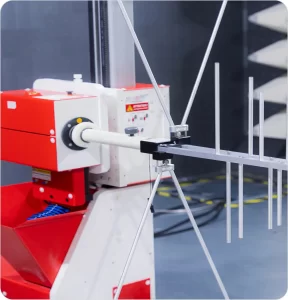
Once hardware, firmware, lab scope, and launch dates are already fixed, there’s very little room to react if OTA or RSE results come back marginal. Teams that map out the FCC → PTCRB → carrier path early — and budget lab time for pre-compliance OTA testing before formal submission — give themselves room to fix antenna or noise issues without blowing the launch date. Many test labs offer anechoic chamber access for exactly this kind of pre-submission check, which reduces the risk of missing a go-to-market deadline.
So the right question isn’t just “did we pass FCC?” It’s “what else does this specific carrier and network require before this product can actually launch?” Those are two different checklists, and only one of them is done when the FCC grant arrives.
How Stancer Testing-Lab Can Help
Stancer Testing-Lab as an EMC Test Lab and RF Testing Lab supports manufacturers and engineering teams with FCC testing and certification support, RF testing, EMC testing, pre-compliance troubleshooting, radiated emissions testing, and conducted emissions testing.
For cellular IoT products, early pre-compliance testing can help identify radiated performance, emissions, integration, and noise-related risks before formal certification and carrier approval timelines become difficult to manage.
Frequently Asked Questions
1. Is FCC approval enough for a cellular IoT device?
FCC approval confirms that the device meets applicable U.S. regulatory requirements, but it does not automatically satisfy PTCRB certification or carrier network acceptance requirements.
2. What is the difference between FCC certification and PTCRB certification?
FCC certification focuses on regulatory compliance, including emissions and radio authorization. PTCRB certification focuses on cellular network performance, RF behavior, antenna integration, SIM interface, and device readiness for carrier networks.
3. Why can a device pass FCC but fail carrier acceptance?
Because carrier acceptance includes requirements that FCC testing does not cover, such as sensitivity, TRP, TIS, OTA performance, and carrier-specific limits.
4. What is OTA testing for cellular IoT devices?
OTA testing evaluates how the finished device performs wirelessly after the module, antenna, enclosure, power supply, and other design elements are integrated into the final product.
5. What are TRP and TIS?
TRP stands for Total Radiated Power and measures how effectively the device transmits. TIS stands for Total Isotropic Sensitivity and measures how effectively the device receives weak signals.
6. What is RSE testing?
RSE means radiated spurious emissions testing. It checks unwanted emissions from the device in idle and active modes, including harmonics and emissions across the operating bands.
7. Does using a certified cellular module eliminate testing?
Not usually. A certified module helps, but the finished product may still require testing because the antenna, enclosure, power supply, SIM interface, and final integration can change the device’s performance.
8. Why do cellular IoT products fail certification?
Many failures are linked to sensitivity problems caused by internal product noise, poor integration, grounding issues, power-supply noise, enclosure effects, or antenna placement challenges.
9. When should cellular IoT teams start planning FCC, PTCRB, and carrier approval?
Planning should begin before hardware is locked. Early pre-compliance testing gives teams room to correct antenna, emissions, noise, and sensitivity problems before formal submission.
Conclusion
FCC approval is an important step, but it is not the final step for cellular IoT products. PTCRB certification and carrier acceptance evaluate different parts of the product’s performance and readiness, especially once the cellular module is integrated into the final device.
If your cellular IoT product needs FCC, RF, EMC, or pre-compliance testing support, Stancer Testing-Lab a fully equipped EMC test lab can help you define the right testing path before certification delays affect your launch.
References
- Federal Communications Commission, FCC Equipment Authorization Rules and Procedures.
- FCC Part 15, Radio Frequency Devices.
- PTCRB Certification Program, Device Certification Requirements.
- CTIA, Test Plan for Wireless Device Over-the-Air Performance.
- 3GPP, Cellular Radio Access Network Specifications.
- Carrier certification and network acceptance requirements from major North American mobile network operators.