
Radiated & Conducted Emissions
We evaluate unwanted emissions transmitted through space and carried on cables, using the applicable setup, detectors and limits. Explore radiated emissions testing and conducted emissions testing.

EMISSIONS · IMMUNITY · PRODUCT COMPLIANCE
Stancer Testing-Lab provides electromagnetic compatibility (EMC) testing services for manufacturers developing products for international markets. We evaluate emissions and immunity for electrical and electronic products, helping your team identify applicable requirements, prepare representative test configurations and obtain documented results. Our EMC testing laboratory is located in Laval, Quebec.
Our A2LA accreditation to ISO/IEC 17025:2017, certificate 7352.01, covers defined EMC and radio test methods. We agree the relevant product standards, test conditions and reporting requirements before your equipment arrives.
Discuss Your EMC Testing Requirements Review Our Accreditation
Emissions testing measures electromagnetic interference (EMI) produced by your equipment. Immunity testing evaluates whether it continues to function as required when exposed to specified disturbances. An EMC compliance testing program brings together the relevant evaluations for your product, intended environment, ports and destination markets.
We evaluate unwanted emissions transmitted through space and carried on cables, using the applicable setup, detectors and limits. Explore radiated emissions testing and conducted emissions testing.
Controlled RF exposure assesses the equipment’s response while agreed functions are monitored. Explore radiated immunity and conducted immunity.
Electrical disturbances can produce resets, communication errors or other functional responses. We apply the selected methods and record behaviour against the agreed criteria. Explore ESD testing and transient testing.
Programs can include harmonics and flicker, power-frequency magnetic fields and voltage dips and interruptions, where applicable.
A product or product-family standard establishes the requirements for a particular category. It may call up several basic test methods. The references below are selected examples from Stancer’s scope; the applicable edition and configuration are confirmed for your project.
For industrial, scientific and medical equipment, CISPR 11 and EN 55011 address emissions within their respective applicability. Multimedia equipment EMC testing can combine CISPR 32 / EN 55032 emissions with CISPR 35 / EN 55035 immunity. Measurement, control and laboratory equipment is evaluated using IEC 61326-1 and relevant listed parts of IEC 61326-2. We check the product classification and intended environment before selecting the requirements.
| Product / application | Selected scope references |
|---|---|
| Industrial, scientific and medical equipment | CISPR 11; BS EN/EN 55011 |
| Multimedia equipment | CISPR 32 / BS EN/EN 55032 emissions; CISPR 35 / BS EN/EN 55035 immunity |
| Medical electrical equipment | IEC 60601-1-2; BS EN/EN 60601-1-2 |
| Measurement, control and laboratory equipment | IEC 61326-1 and listed IEC 61326-2 methods |
| Automotive vehicles and components | CISPR 12; CISPR 25 clauses 6.3, 6.4 and 6.5; listed ISO automotive methods; ECE Regulation 10 |
| Radio equipment EMC | Listed EN 301 489 parts |
| North American emissions requirements | FCC Part 15 Subpart B; listed ICES requirements including ICES-003 |
See our dedicated medical device EMC, automotive EMC and RF and wireless testing pages for application-specific programs.
Basic methods describe how a disturbance is measured or applied. They do not, on their own, determine every requirement for the finished product.
| Evaluation | IEC reference |
|---|---|
| Electrostatic discharge | IEC 61000-4-2 |
| Radiated RF immunity | IEC 61000-4-3 |
| Electrical fast transients / burst | IEC 61000-4-4 |
| Surge immunity | IEC 61000-4-5 |
| Conducted RF immunity | IEC 61000-4-6 |
| Power-frequency magnetic-field immunity | IEC 61000-4-8 |
| AC voltage dips, interruptions and variations | IEC 61000-4-11 |
| DC voltage dips, interruptions and variations | IEC 61000-4-29 |
| Harmonic current emissions | IEC 61000-3-2; IEC 61000-3-12 |
| Voltage fluctuations and flicker | IEC 61000-3-3; IEC 61000-3-11 |
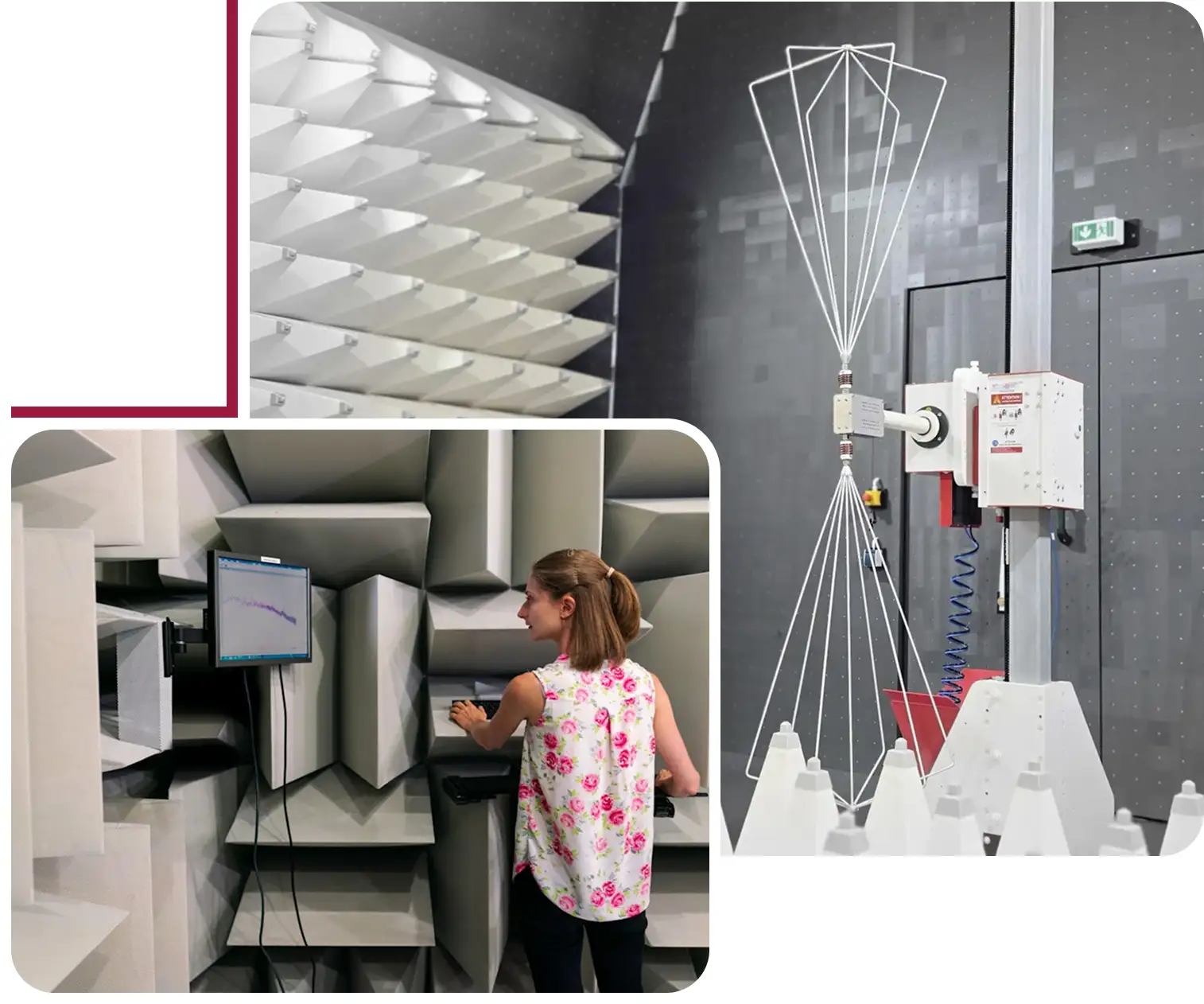
Our dome-shaped SAC PLUS semi-anechoic chamber offers usable dimensions of 8.5 × 5 × 6 m, a 2 × 2 m door and EUT capacity up to 2,000 kg. An automated antenna tower and turntable use Rohde & Schwarz ELEKTRA and dedicated control systems.
Instrumentation includes a Rohde & Schwarz ESW receiver with coverage to 44 GHz, RF signal generators, high-power amplifiers across applicable bands up to 6 GHz, LISNs, power meters, antennas, transient generators and harmonic/flicker systems.
Applicable setups support 200 A, three-phase EUT current and RF immunity fields up to 200 V/m. These are maximum capabilities, not levels available for every method or frequency. Specialist RF measurement arrangements extend to 325 GHz; the selected test program identifies the usable range and accredited activities.
The chamber uses site-performance verification for NSA, field uniformity and sVSWR as applicable. An RFI trap supports cable feedthroughs, while built-in filtering and additional setup filtering can help control external conducted noise. Explore the chamber and laboratory capabilities.
Provide a product description, dimensions, mass, supply voltage and current, operating modes, cable and port information, accessories, firmware version, target markets and requested schedule. Include monitoring instructions and any customer test specification.
Start with our EMC & RF Client Information Sheet to describe the equipment and test configuration. For specialist applications, use our medical EMC preparation checklist or automotive EMC preparation checklist for those applications.
The required route depends on the product and destination. Stancer supports applicable EMC testing and technical documentation for FCC requirements, ISED requirements, CE marking and VCCI conformity.
Radio, electrical safety and other product requirements are identified separately where relevant. A test report documents the agreed evaluation; certification or approval proceeds through the appropriate process. See global market access support.
Electromagnetic compatibility testing evaluates the disturbances a product emits and its ability to function when exposed to electromagnetic disturbances. The applicable product standards define the emissions limits, immunity test levels and performance criteria. The test program depends on the equipment, intended environment and target markets.
EMC testing cost depends on the applicable standards, number of tests, operating modes, ports, sample configurations and time needed for setup and functional monitoring. Bulky equipment, special power arrangements and troubleshooting can affect the program. Send your product specifications and target markets for a project-specific EMC testing quote; any design changes and retesting are agreed separately.
That depends on the product category, intended environment and target markets. Send those details and any customer specification so we can determine the relevant product standard and basic methods.
Emissions concern disturbances produced by the equipment. Immunity concerns its response to applied disturbances. The applicable product requirements determine which evaluations are needed.
No. Pre-compliance supports design investigation and troubleshooting. Formal testing follows the agreed compliance program and produces the corresponding documented results.
We review the proposed equipment against access, mass, supply and measurement requirements. Available setups include EUT capability up to 200 A, three-phase; chamber access and clearance are confirmed before booking.
They may. Host electronics and radio functions can have different requirements. We coordinate the applicable evaluations within the proposed program.
We document the result and can investigate the response with your engineering team. Any changes and retesting are agreed before proceeding, with the tested configuration recorded.
Send your product details and destination markets. Our engineers will help define the setup, test sequence and documentation for your program.
Complete our Client Information Sheet before testing. It captures your target markets, product details, power requirements, interfaces, operating modes and monitoring arrangements so our team can plan the assessment.
What to Prepare Before Testing
Send the completed form to info@stancermtl.com. Our technical team will confirm the sample configurations and test requirements for your product.
Plan your testing
Tell us about your product and target markets. Our technical team will help clarify the testing scope and prepare a tailored quotation.