
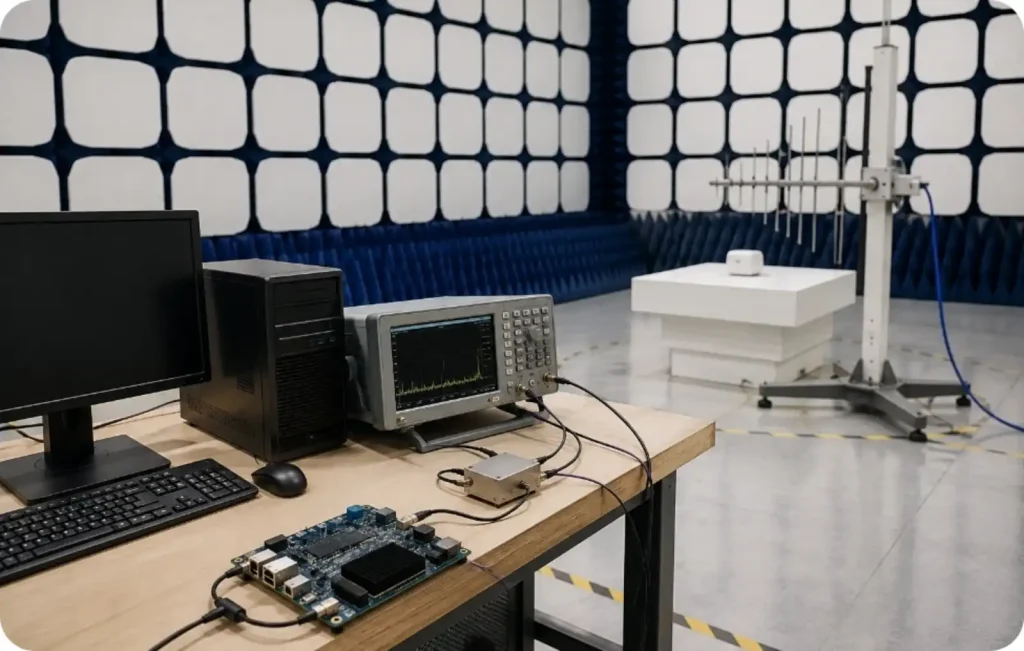
Conducted Emissions
Measure RF disturbances on applicable AC mains connections under the required Part 15 limits and measurement setup.
Measurements are selected for the applicable FCC rule section and product configuration. A transmitter program and a digital-device emissions program can require different tests and measurement methods.
Measure RF disturbances on applicable AC mains connections under the required Part 15 limits and measurement setup.
Evaluate emissions from digital electronics and other applicable unintentional radiators in the required operating configurations.
Measure conducted or radiated transmitter power as required for the technology, antenna configuration and applicable rule section.
Evaluate the required bandwidth and, where applicable, power spectral density. The metric and measurement settings depend on the rule.
Evaluate emissions at the edges of the operating band against the applicable limits, using the required detector and measurement bandwidth.
Measure harmonics and other unwanted transmitter emissions. Applicable limits and frequency ranges depend on the operating band and rule section.
| Product function | Requirements to review | Planning point |
|---|---|---|
| Digital electronics | Part 15 Subpart B | Determine applicable emissions limits, exemptions and SDoC or certification requirements. |
| Many 2.4 GHz licence-exempt radios | Applicable Subpart C sections, such as 15.247 | Technology and operating parameters determine the rule and measurement program. |
| U-NII equipment | Part 15 Subpart E | Band and device category affect requirements. Agree the pathway for DFS and other specialist functions. |
| Other radio technologies | Other applicable Part 15 subparts or licensed-radio rules | Cellular and other licensed-radio devices are not automatically covered by Part 15. |
| ISM equipment | Part 18, where applicable | Part 18 is a separate framework; an industrial or medical application alone does not establish its applicability. |
Testing generates evidence for the applicable authorization route. The product manufacturer and responsible party retain their compliance obligations; where certification is required, the certification decision is made by the appropriate recognized TCB.
Identify digital circuitry, radio functions, operating frequencies, antenna options and intended use.
Select the rule sections, methods, limits and required worst-case configurations. Review accredited coverage and any specialist testing pathway.
Evaluate the agreed configurations and record emissions or transmitter measurements against the applicable requirements.
Document the setup, operating modes, measurement data and results. Review any findings that require corrective work or retesting.
Prepare the evidence for SDoC or the applicable certification submission. A recognized TCB makes the certification decision where required.
Address the required labeling, user information and responsible-party obligations. Confirm applicable authorization before marketing.
Practical answers for electronic products, radio modules and licence-exempt transmitters.
Plan your testing
Tell us about your product, testing needs, and target markets. Our technical team will help define the scope and prepare a tailored quotation.