
How to Choose a Best-Fitted EMC Lab
How Environmental Conditions Affect EMC Testing Results — and How to Choose the Right EMC Laboratory
For manufacturers, EMC testing is not just a regulatory checkpoint. It is the point where product design, laboratory discipline, measurement accuracy, and real-world reliability meet. The quality of the test environment and the competence of the laboratory can directly influence whether your product reaches the market smoothly or returns to engineering for another redesign cycle.
As a manufacturer, ensuring that your electrical or electronic product meets electromagnetic compatibility requirements is essential for regulatory approval, market access, product reliability, and customer confidence. A failed EMC test can delay launch, trigger redesign, increase certification costs, or create compliance concerns after the product is already in the field.
Accurate EMC testing depends on more than simply placing a product in a chamber and pressing “start.” The result is shaped by the test environment, instrumentation, calibration status, chamber performance, ambient electromagnetic noise, humidity, temperature, test setup, cable layout, operating mode, and the technical judgment of the laboratory team.
This guide explains how environmental factors affect EMC test results and what manufacturers should look for when selecting an EMC laboratory. It also highlights why an ISO/IEC 17025 accredited testing laboratory is often the safest path for reliable, defensible, and internationally accepted test data.
Engineering insight: EMC testing is a measurement discipline. A good test result is not only a pass/fail statement; it is a traceable technical record that must be repeatable, explainable, and defensible if questioned by a regulator, customer, OEM, or certification body.
Why the Test Environment Matters in EMC Testing
The electromagnetic environment surrounding the device under test can significantly influence measured emissions and immunity performance. In a well-controlled EMC laboratory, the goal is to isolate the product’s behavior from unrelated external disturbances so that the final result reflects the product itself, not the test site.
Environmental effects may come from several sources: temperature, humidity, power quality, vibration, nearby RF transmitters, external broadcast signals, industrial equipment, grounding conditions, chamber reflections, and even the way auxiliary equipment is configured. If these factors are not controlled, the laboratory may measure noise that does not belong to the product, miss an actual product issue, or produce results that cannot be repeated later.
| Environmental Factor | How It Can Affect EMC Testing | Why It Matters |
|---|---|---|
| Temperature | Can alter oscillator behavior, semiconductor performance, power supply switching, and material properties. | May change emissions, immunity response, or functional performance during testing. |
| Humidity | Can influence insulation resistance, static charge behavior, leakage paths, and ESD repeatability. | Important for ESD testing and long-duration validation. |
| Ambient RF noise | External radio, cellular, Wi-Fi, broadcast, or industrial signals may appear in measurement traces. | Can lead to false failures or uncertainty during radiated emissions testing. |
| Power quality | Distorted mains voltage or unstable supply conditions may change product behavior. | Can affect emissions, immunity, harmonic current, and flicker performance. |
| Chamber or site performance | Reflections, absorber quality, ground plane behavior, and shielding effectiveness influence results. | Critical for repeatable measurements and international acceptance. |
Temperature and Humidity Control
Temperature and humidity are often underestimated in EMC testing, yet they can affect both the device under test and the laboratory measurement system. A product that is stable at room temperature may behave differently when components warm up, when oscillator drift changes timing, or when switching power supplies operate at different thermal points.
Humidity is particularly important for electrostatic discharge behavior. Low humidity can increase static charge buildup, while high humidity can change surface leakage behavior and insulation resistance. For products with high impedance sensing circuits, medical electronics, exposed connectors, or polymer enclosures, these effects can be relevant to both immunity and safety-related performance.
A competent laboratory monitors and records environmental conditions during testing. This is not simply administrative paperwork. It helps confirm that the test was performed within the allowed range of the applicable standard and that the result can be interpreted correctly if questions arise later.
Laboratory observation: When a product fails intermittently during immunity testing, environmental conditions are one of the first details worth reviewing. Temperature, humidity, cable position, supply voltage, and operating mode can all influence whether a borderline problem appears during the test.
Shielding, Ambient Noise, and External Interference
EMC measurements are only meaningful when the laboratory can distinguish product emissions from background electromagnetic noise. External interference from mobile networks, broadcast transmitters, nearby industrial equipment, power lines, and wireless devices can contaminate measurement results if the test environment is not properly controlled.
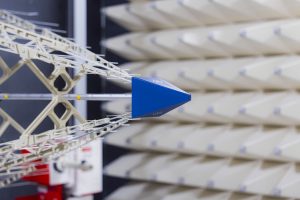
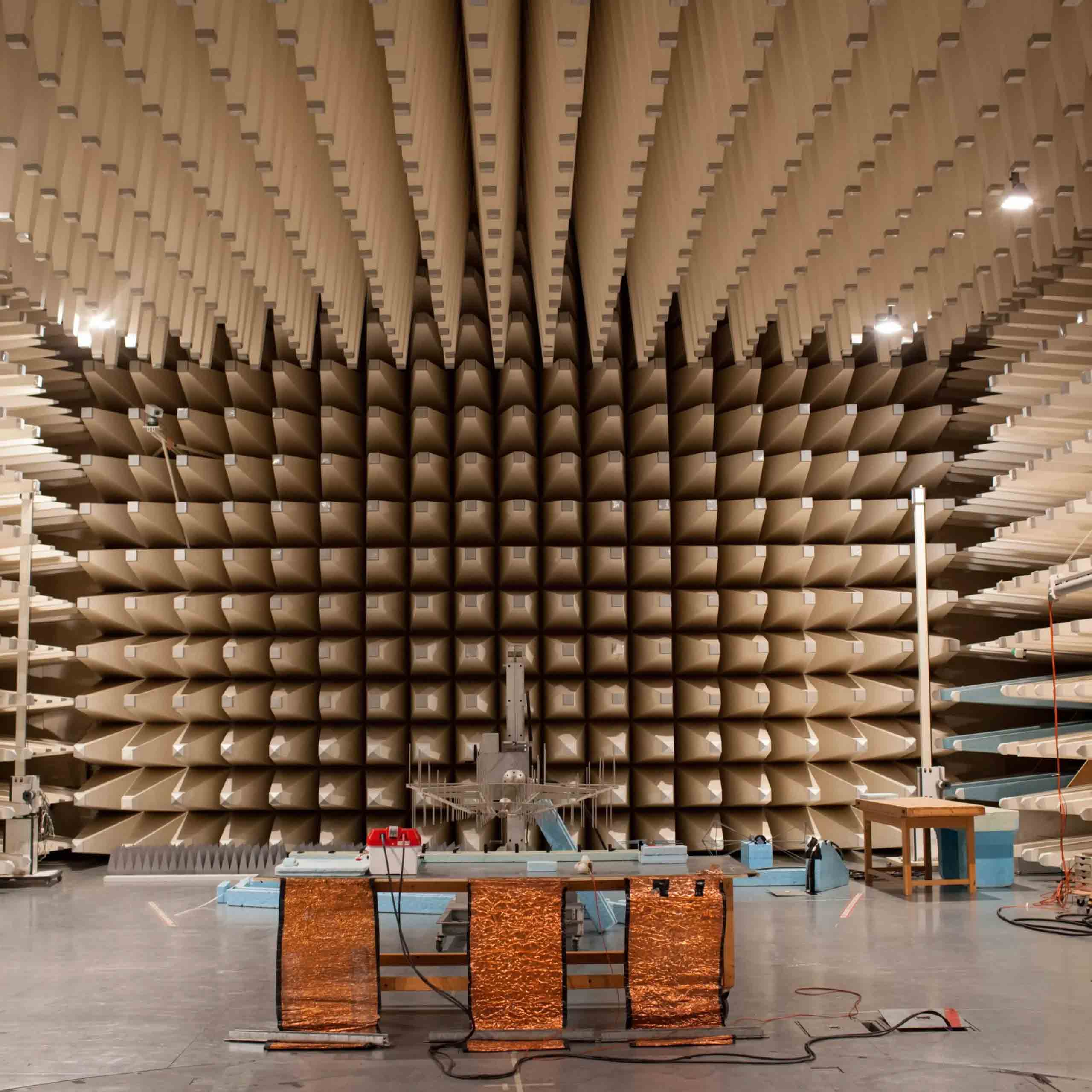
This is why radiated emissions testing is commonly performed in semi-anechoic chambers, absorber-lined shielded enclosures, or validated open-area test sites. The chamber shielding reduces outside signals, while absorbers and controlled geometry improve measurement repeatability.
For conducted emissions testing, external disturbances can enter through power lines, auxiliary equipment, or grounding paths. Proper LISN setup, cable routing, grounding, and background checks are essential to avoid confusing laboratory noise with product noise.
Why Ambient Scans Are Important
Before measuring the product, laboratories typically evaluate the ambient noise floor. If the ambient level is too close to the applicable limit line, it becomes difficult to determine whether a peak is generated by the product or by the surrounding environment. A well-managed lab identifies these issues before formal data are collected.
This is especially important for low-level emissions, high-frequency testing, wireless products, and products with narrow compliance margins.
Calibration and Measurement Traceability
Test equipment such as EMI receivers, spectrum analyzers, antennas, LISNs, current probes, field probes, RF amplifiers, signal generators, CDN networks, ESD simulators, surge generators, and EFT generators must be calibrated at appropriate intervals. Calibration confirms that the equipment is operating within defined specifications and that measurement results are traceable to national or international standards.
Without proper calibration, a laboratory may report inaccurate field strengths, incorrect conducted emission levels, or improper immunity stress levels. This can lead to false confidence, unnecessary redesign, rejected reports, or certification delays.
Practical point: Calibration is not just a certificate in a folder. It is part of the measurement chain that supports the credibility of every number in the final report.
How Poor Test Setup Can Create Unreliable Results
Even with a good chamber and calibrated equipment, the test setup must be configured correctly. EMC testing is highly sensitive to cable placement, grounding, load conditions, auxiliary equipment, operating mode, connector configuration, test distance, antenna height, polarization, and product orientation.
A small setup deviation can change the measured result. A cable routed differently may radiate more strongly. A product tested in standby mode may appear compliant while failing in full operating mode. A wireless product tested at low transmit power may pass while failing at maximum power. This is why standardized methods and experienced laboratory staff matter.
Examples of Setup Details That Influence Results
- Operating mode of the equipment under test.
- Length, routing, and termination of cables.
- Use of real auxiliary equipment or representative loads.
- Power supply configuration and grounding method.
- Device orientation during radiated measurements.
- Antenna distance, height scan, and polarization.
- Receiver detector type, resolution bandwidth, and measurement dwell time.
- Firmware state, wireless transmit mode, and worst-case loading.
For wireless products, test setup also affects wireless RF testing, antenna behavior, radiated spurious emissions, receiver performance, and RF exposure assessment. For medical products, setup can affect essential performance monitoring under IEC 60601-1-2 conditions. For automotive electronics, harness layout and grounding are central to reliable results under standards such as CISPR 25, ISO 11452, and UNECE R10.
Standardized Test Protocols Reduce Uncertainty
Reliable EMC testing depends on standards-based procedures. International standards such as IEC, CISPR, ISO, ANSI, FCC, ISED, and ETSI methods define how tests should be performed, what equipment should be used, how the product should be configured, and how results should be interpreted.
Using recognized standards helps ensure that results are comparable between laboratories and accepted by regulators, certification bodies, OEMs, and international customers.
| Test Area | Typical Standards or Methods | Purpose |
|---|---|---|
| Radiated emissions | CISPR 32, CISPR 11, ANSI C63.4, FCC Part 15 | Measures electromagnetic fields radiated by the product. |
| Conducted emissions | CISPR 32, CISPR 11, IEC/CISPR methods | Measures disturbances conducted onto power or signal lines. |
| Immunity testing | IEC 61000-4 series | Evaluates product resilience to ESD, RF fields, surge, EFT, dips, and conducted disturbances. |
| Wireless/RF testing | FCC, ISED RSS, ETSI EN standards | Confirms radio performance, spectrum use, spurious emissions, and power limits. |
| Medical EMC | IEC 60601-1-2 | Evaluates EMC while maintaining safety and essential performance. |
| Automotive EMC | CISPR 25, CISPR 12, ISO 11452, ISO 7637, UNECE R10 | Supports component, ESA, and vehicle-level EMC validation. |
Comprehensive Test Configurations Reflect Real Use
One of the most common mistakes in EMC planning is testing only a convenient operating mode rather than a representative or worst-case condition. A product should be exercised in the modes most likely to generate emissions or show susceptibility.
For example, a motor controller may need to be tested at different speeds and loads. A wireless device may need continuous transmit mode, receive mode, idle mode, and co-transmit conditions. A charger may need testing during startup, fast charge, trickle charge, and battery transition. A product with a display, processor, motor, heater, pump, or RF transmitter may have different EMC behavior depending on operating state.
Design and test planning tip: Before scheduling formal compliance testing, define worst-case operating modes. A good laboratory will ask how the product behaves, what modes are possible, and which conditions are most stressful from an EMC perspective.
Choosing the Right EMC Lab
Selecting the right EMC laboratory is one of the most important decisions in the compliance process. The lab you choose will influence not only the accuracy of your results but also the efficiency of your project, the quality of your documentation, and the confidence of your customers or regulators.
1. Accreditation and Recognition
Look for an ISO/IEC 17025 accredited laboratory with a scope that matches your product and target standards. Accreditation confirms that the laboratory has demonstrated technical competence, quality controls, measurement traceability, and impartiality.
For manufacturers seeking regulatory approval or international market access, accredited reports are often far more defensible than informal measurements. Stancer Testing-Lab operates as an ISO/IEC 17025 accredited laboratory, supporting manufacturers with credible EMC and RF test data.
2. Experience With Your Product Category
Different industries have different EMC risks. Consumer electronics, medical devices, industrial controls, automotive components, lighting products, telecommunications equipment, and wireless IoT products all present different test configurations and failure modes.
A laboratory familiar with your product category can help identify realistic operating modes, applicable standards, likely failure points, and documentation needs. This is particularly valuable for medical devices, automotive EMC testing, telecommunications products, and connected wireless equipment.
3. Modern Facilities and Appropriate Equipment
The laboratory should have the right facilities for your product’s size, frequency range, power level, operating mode, and test standard. Semi-anechoic chambers, conducted emissions benches, LISNs, antennas, EMI receivers, RF amplifiers, ESD simulators, surge generators, EFT generators, CDNs, clamps, and monitoring systems should match the intended test program.
For wireless products, the lab should also be capable of performing RF measurements such as output power, occupied bandwidth, spurious emissions, band edge compliance, receiver behavior, and radiated RF performance where applicable.
4. Environmental Control and Ambient Noise Management
A reliable EMC lab controls temperature, humidity, grounding, shielding, ambient noise, and power quality. These controls reduce the risk of unreliable results and support repeatable measurements.
This is particularly important for products with narrow compliance margins, low-level emissions, sensitive analog inputs, wireless receivers, medical monitoring functions, or high-power switching electronics.
5. Clear Reporting and Engineering Communication
A strong EMC report should do more than state pass or fail. It should describe the product configuration, operating modes, test setup, applied standards, instrumentation, environmental conditions, deviations, uncertainty where applicable, and measurement results clearly enough that another technical reviewer can understand what was done.
Good communication during testing is equally important. If a failure occurs, manufacturers need timely information, meaningful plots, operating mode details, and practical engineering feedback so that corrective action can begin quickly.
What a Good EMC Test Report Should Include
| Report Element | Why It Matters |
|---|---|
| Product identification | Confirms the exact model, version, configuration, and sample tested. |
| Applied standards | Shows the regulatory or customer requirements used for evaluation. |
| Operating modes | Demonstrates that the product was tested under representative or worst-case conditions. |
| Test setup details | Allows the measurement configuration to be understood and repeated. |
| Instrumentation and calibration | Supports traceability and technical credibility. |
| Environmental conditions | Confirms that testing was performed within acceptable limits. |
| Results and limit comparisons | Shows compliance margin and identifies any failing frequencies or conditions. |
| Deviations or special conditions | Documents any differences from the standard method or product-specific setup. |
How to Reduce the Risk of Late EMC Failure
Manufacturers can reduce compliance risk by treating EMC as part of product development rather than a final administrative step. The earlier EMC concerns are considered, the easier they are to fix.
Practical EMC Risk-Reduction Checklist
- Review applicable standards before PCB layout begins.
- Identify worst-case operating modes before scheduling lab time.
- Plan pre-compliance testing before formal certification.
- Use representative cables, loads, accessories, and power supplies during testing.
- Verify that test modes are available in firmware.
- Confirm that the lab’s accreditation scope matches your required standards.
- Ask how the lab controls ambient noise and environmental conditions.
- Request clear plots and early feedback if failures occur.
- Keep test reports, design changes, and compliance decisions in the technical file.
How Stancer Testing-Lab Supports Reliable EMC Testing
Stancer Testing-Lab supports manufacturers with accredited EMC and RF testing services for electronic, wireless, automotive, medical, industrial, and telecommunications products. Our services include EMC testing, RF testing, radiated emissions testing, conducted emissions testing, radiated immunity testing, conducted immunity testing, ESD testing, and harmonic and flicker testing.
By combining controlled test environments, calibrated instrumentation, practical engineering support, and structured reporting, Stancer helps manufacturers obtain reliable data and move more confidently toward product certification and global market access.
Frequently Asked Questions
Why do environmental conditions matter in EMC testing?
Environmental conditions such as temperature, humidity, ambient RF noise, and power quality can influence product behavior and measurement accuracy. Controlling these factors helps ensure that the test result reflects the product rather than the surrounding environment.
How can humidity affect EMC or ESD testing?
Humidity can change static charge behavior, surface leakage, and insulation performance. It is especially important during ESD testing, where discharge behavior can vary significantly with environmental conditions.
Why is a shielded chamber important for radiated emissions testing?
A shielded chamber reduces external electromagnetic noise so the laboratory can measure emissions generated by the product itself. This improves repeatability and reduces the risk of false failures caused by outside signals.
What does ISO/IEC 17025 accreditation mean for an EMC lab?
ISO/IEC 17025 accreditation demonstrates that a laboratory has been assessed for technical competence, measurement traceability, quality management, impartiality, and ability to produce valid test results within its accredited scope.
Can uncalibrated equipment affect EMC test results?
Yes. Uncalibrated or out-of-tolerance equipment can produce inaccurate measurements, incorrect immunity levels, or unreliable pass/fail decisions. Calibration is essential for defensible EMC data.
What should manufacturers check before choosing an EMC lab?
Manufacturers should review the lab’s accreditation, scope of testing, industry experience, facilities, equipment, environmental controls, reporting quality, and ability to support the required standards and product category.
Why do EMC test setups need to be standardized?
Standardized setups reduce variability and help ensure that results are repeatable and comparable between laboratories. Cable layout, product orientation, grounding, operating mode, and antenna geometry can all affect results.
What is the difference between pre-compliance and formal EMC testing?
Pre-compliance testing is an early engineering evaluation used to identify risks before certification. Formal EMC testing is performed according to applicable standards and produces regulatory-grade test results.
Why should products be tested in worst-case operating modes?
EMC behavior changes with operating mode. A product may emit more noise or become more susceptible during high load, wireless transmission, charging, motor operation, display activity, or processor-intensive states.
What should an EMC test report include?
A good EMC report should include product identification, applied standards, operating modes, test setup, instrumentation, calibration status, environmental conditions, results, limits, deviations, and clear pass/fail conclusions.
Can an EMC lab help troubleshoot failures?
Yes. Experienced EMC laboratories can help identify likely root causes, review plots, suggest mitigation strategies, and support pre-compliance troubleshooting before formal retesting.
How does Stancer Testing-Lab support manufacturers?
Stancer Testing-Lab supports manufacturers with accredited EMC and RF testing, pre-compliance evaluation, emissions and immunity testing, wireless testing, technical reporting, and regulatory planning for North American and global markets.
Useful External References
1. International Electrotechnical Commission (IEC): https://www.iec.ch/
2. CISPR standards information through IEC: IEC CISPR information
3. ISO/IEC 17025 information from ISO: ISO/IEC 17025
4. FCC Equipment Authorization: https://www.fcc.gov/oet/ea
5. ISED Canada devices and equipment requirements: ISED devices and equipment