
WiFi & Bluetooth Wireless Testing Services
Stancer Testing-Lab supports Wi-Fi and Bluetooth RF testing for connected products. We define the measurements and configurations for the applicable radio rules, with separate consideration of the host product and intended markets.
Plan Your Test Program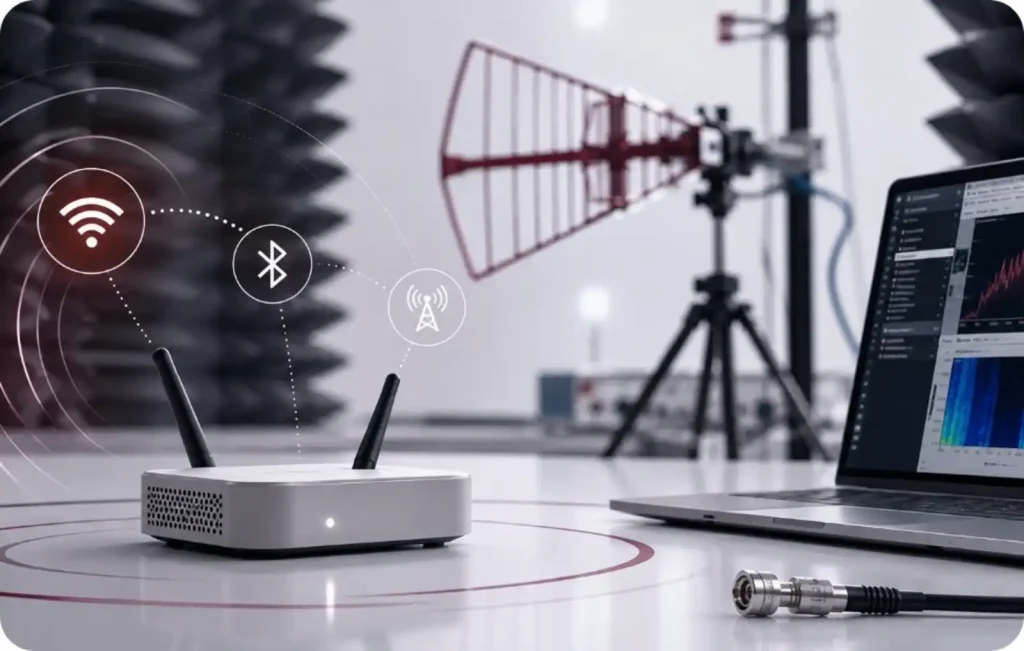
Wi-Fi and Bluetooth Test Planning
5 GHz Wi-Fi
Operating sub-band, device category, indoor or outdoor use and radar-detection requirements affect the test plan. Confirm DFS and other specialist testing pathways.6 GHz Wi-Fi
For Wi-Fi 6E and other 6 GHz radios, review device class, band restrictions and country-specific requirements. Confirm the applicable scope and testing pathway.Bluetooth Classic and BLE
BR/EDR and Bluetooth Low Energy configurations can have different hopping, modulation and channel characteristics. Regulatory RF testing is distinct from Bluetooth SIG qualification.RF Measurements That Matter
Power and spectrum
Evaluate conducted power or radiated power, power spectral density and the applicable bandwidth measures for the selected rule and mode.Band edges and unwanted emissions
Measure emissions near band boundaries and at harmonics or other frequencies using the required detector, bandwidth and operating configuration.Antennas and operating modes
Review MIMO, antenna gain, beamforming, duty cycle and simultaneous transmission. Agree representative and worst-case configurations before measurements.Requirements to Review Before Testing
The applicable rule, standard edition and laboratory scope are confirmed for the product and target market before testing.| Market or function | Requirements to consider | Planning point |
|---|---|---|
| 2.4 GHz — United States | FCC 15.247 and other applicable Part 15 requirements | Choose the rule based on modulation and operation; applicable measurement methods are identified in the test plan. |
| 5 / 6 GHz — United States | FCC Part 15 Subpart E | Band, device class and operating restrictions determine requirements. Specialist functions need an agreed pathway. |
| Canada | RSS-Gen, applicable RSS-247 or RSS-248, and RSS-102 | Use the applicable edition and transition requirements rather than treating earlier RSS issues as interchangeable. |
| 2.4 GHz — European Union | ETSI EN 300 328 and applicable EN 301 489 parts | Radio and EMC requirements support relevant RED obligations; other RED requirements must also be addressed. |
| 5 / 6 GHz — European Union | Applicable EN 301 893 or EN 303 687 requirements | Confirm the applicable band, standard status, edition and available laboratory scope for the conformity route. |
Plan the Complete Connected Product
A radio module, its antenna and the finished host need to be considered together. Stancer supports wireless device compliance planning, FCC Part 15 testing, ISED compliance and EMC evaluation for teams targeting international markets. We confirm method-specific accredited coverage before testing. Regulatory RF reports do not substitute for Wi-Fi Alliance certification, Bluetooth SIG qualification, interoperability validation or all requirements of the European RED.Prepare Your Product for Testing
- 01
Define the markets
List the countries, operating bands, antenna options and intended installation or use. - 02
Provide radio controls
Supply firmware, test-mode instructions and tools for selecting channels, bandwidths and output-power settings. - 03
Build a representative setup
Include production antennas, cables, power supplies, accessories and the host product when assessing a module integration. - 04
Prepare the evidence
Share existing approvals, module integration instructions, schematics, block diagrams, manuals and proposed labels.
Frequently Asked Questions
What is included in Wi-Fi and Bluetooth RF testing?
Depending on the rule and technology, the program can include transmitter power, power spectral density, bandwidth, band-edge and unwanted emissions measurements. The applicable configuration and additional requirements are defined before testing.Is Bluetooth RF testing the same as Bluetooth qualification?
No. FCC, ISED and European radio testing evaluates regulatory requirements. Bluetooth SIG qualification is a separate process with its own requirements; this service does not claim to replace that process.Do all Wi-Fi bands use the same requirements?
No. 2.4 GHz, 5 GHz and 6 GHz radios have different band and operating requirements. Device class, modulation, antenna configuration and intended country affect the test plan.Can I use an existing Wi-Fi or Bluetooth module approval?
Possibly, if the integration meets its approval conditions. Changes to antennas, power, firmware, host configuration or simultaneous transmission may require additional review and testing.Do you include DFS or 6 GHz testing automatically?
No. We review applicability, the required method and available laboratory scope first. Any specialist testing or additional assessment pathway is agreed as part of the quotation.What test firmware and accessories are needed?
Provide stable controls for selecting channels, bandwidths, modes and power levels, plus production antennas, cables and power supplies. For a module integration, include the representative host and integration documentation.Plan your testing
Let’s move your product toward market.
Tell us about your product, testing needs, and target markets. Our technical team will help define the scope and prepare a tailored quotation.