
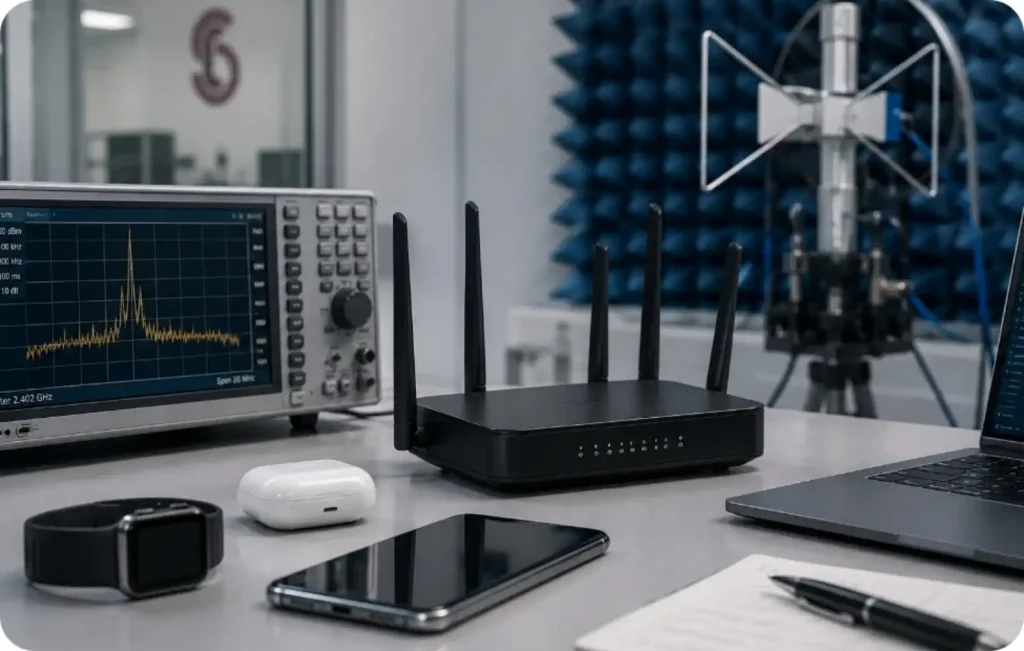
Wireless Device Compliance Testing
Wireless products must meet applicable radio frequency (RF), electromagnetic compatibility, and regulatory requirements before they can be placed on the market. Stancer Testing-Lab provides wireless device compliance testing for manufacturers developing products incorporating technologies such as Wi-Fi and Bluetooth wireless testing, Zigbee, Z-Wave, LoRa, RFID, NFC, and other intentional radio transmitters. For broader transmitter characterization and regulatory measurements, see our RF Testing Lab services.
As an ISO/IEC 17025 accredited testing laboratory in Canada, Stancer supports manufacturers with RF testing, EMC testing, and regulatory compliance for the United States, Canada, Europe, and international markets. Our laboratory helps manufacturers identify applicable requirements, perform the required measurements, and prepare their products for certification and global market access.
Our wireless compliance programs can combine RF, EMC, FCC, ISED and European regulatory requirements into one coordinated testing strategy.
Wireless RF Testing Services
Stancer provides RF testing for wireless and connected products operating across a broad range of frequencies and applications. Depending on the radio technology and target market, testing can include transmitter output power, occupied bandwidth, band-edge measurements, frequency stability, unwanted and spurious emissions, radiated emissions, and other applicable regulatory measurements.
Our laboratory supports standalone transmitters as well as products incorporating multiple wireless technologies or pre-certified radio modules. Manufacturers can also review our RF Testing Laboratory capabilities for broader wireless and radio compliance programs.
FCC Testing
FCC Part 15 & Part 18
For products intended for the U.S. market, Stancer provides testing to applicable FCC requirements. Our dedicated FCC Part 15 testing service supports manufacturers of intentional and unintentional radiators through applicable compliance measurements and documentation.
- FCC Part 15B unintentional radiator testing — measurements using applicable ANSI C63.4 procedures for equipment subject to SDoC or certification requirements.
- FCC Part 15C intentional radiator testing — RF measurements using applicable ANSI C63.10 procedures.
- FCC Part 15E U-NII testing — including applicable requirements for 5 GHz and 6 GHz radio devices.
- FCC Part 18 ISM testing — for applicable industrial, scientific, and medical equipment.
- FCC certification testing — compliance measurements and technical documentation supporting the FCC equipment authorization process.
- FCC Part 15 testing — evaluation to applicable Part 15 requirements based on the device technology and operating frequency.
- FCC equipment authorization support — guidance related to labeling, product modifications, permissive changes, and certification documentation.
For a broader overview of the approval process, see our guide to FCC and ISED certification for radio devices .
Wi-Fi, Bluetooth & IoT Testing
Wi-Fi, Bluetooth & Wireless Protocol Testing
- Wi-Fi & Bluetooth Wireless Testing — including 2.4 GHz testing to applicable requirements such as ETSI EN 300 328, as well as applicable 5 GHz and 6 GHz requirements.
- Zigbee testing — for devices based on IEEE 802.15.4 and related 2.4 GHz applications.
- Z-Wave testing — for applicable sub-GHz wireless devices.
- LoRa and LPWAN testing — including devices operating in commonly used sub-GHz frequency bands.
- NFC testing — including applicable FCC Part 15.225 and ETSI EN 300 330 requirements.
- RFID testing — including LF, 13.56 MHz HF, and UHF RFID applications.
- IoT device testing — coordinated compliance programs for products incorporating multiple radio technologies.
Manufacturers developing connected products can also review our article on regulatory compliance for IoT devices , which discusses common certification and market-access considerations for wireless products.
Short-Range Devices & RF Exposure
SRD, RF Exposure & ETSI Testing
For wireless products intended for Canada, Europe, the United States, and other markets, testing may also involve short-range-device, RF exposure, and EMC requirements.
- Short-range device (SRD) testing — including applicable ETSI EN 300 440 and EN 300 220 requirements.
- Inductive radio equipment testing — including applicable ETSI EN 300 330 requirements.
- RF exposure evaluation and testing — according to applicable FCC, ISED RSS-102, and other RF exposure requirements.
- ETSI RED testing — supporting compliance with applicable requirements under the Radio Equipment Directive (RED) 2014/53/EU.
- ETSI EN 301 489 EMC testing — according to applicable parts of the EN 301 489 series for radio equipment.
- Wireless charging evaluation — including applicable FCC and RF exposure considerations.
Products intended for the Canadian market may also require ISED certification under the applicable RSS requirements.
RF Testing for FCC, ISED and European Compliance
The regulatory requirements applicable to a wireless device depend on its operating frequencies, radio technology, output power, intended use, and target markets. Identifying these requirements early in product development can significantly reduce the risk of failed compliance testing, redesign, and delays during certification.
Stancer Testing-Lab works with manufacturers to establish an efficient compliance program covering applicable FCC, ISED, CE/RED, ETSI, EMC, and RF testing requirements.
Whether your product is intended for Canada, the United States, Europe, or multiple international markets, our engineers can help determine the applicable tests and support the product through the compliance process.
For additional information about our laboratory capabilities, visit our RF Testing Laboratory page or contact Stancer Testing-Lab to discuss your wireless product and target markets.