
Generic EMC Standards for Emission and Immunity Testing
Generic EMC Standards for Emission and Immunity Testing
As part of EMC Testing and Regulatory compliance support, we observe frequently that for a given equipment, the manufacturer and the engineering team do not have a clear idea about the applicable EMC standard they may need to get their product certified. In fact, the EMC standards cannot keep up with the rapid evolution of Technology, so a lot of new product types end up with no clear standard to follow. That’s where generic standards come in. The benefit is that instead of writing rules for every single product type, the generic standards set EMC test requirements based on where the product will actually be used.
The IEC 61000-6 series is the main group of generic EMC standards used worldwide. It’s built around two simple questions: what kind of environment is the product used in (residential/commercial or industrial), and what’s being tested (emissions or immunity). So no matter what a product does or which market it’s sold in, you can usually find a generic standard that fits just by knowing where it’ll be installed.
These generic standards tell you the test limits and when each test applies, but they don’t reinvent the actual test methods — those come from the IEC 61000-4 series (for immunity) and CISPR publications (for emissions). This keeps things simple: the limits can stay put while the underlying test methods get updated on their own schedule.
Note: When should you actually use a generic standard? Only when there isn’t a more specific one for your product. If your product already has its own dedicated standard — like CISPR 32 for multimedia equipment or IEC 61326-1 for measurement equipment — that one wins. Generic standards are just the backup option when nothing more specific applies.
The Four Generic Standards
The IEC 61000-6 series breaks down into four standards, split by environment and by what’s being tested. Each one comes in both an IEC (international) version and an EN (European harmonized) version.
Immunity IEC/EN 61000-6-1 — Residential, Commercial & Light Industrial
This one covers immunity test levels for equipment in that same residential/commercial setting. It tests against things like ESD, radiated RF fields, fast transients, surge, conducted RF disturbances, power-frequency magnetic fields, and voltage dips and interruptions — basically the electromagnetic disturbances you’d expect in a typical home or office building.
IEC 61000-6-1 draws its test methods from the IEC 61000-4 series, matching each type of disturbance to the right test level and pass/fail criteria for this environment.
IEC 61000-4-2: Electrostatic Discharge (ESD) ±4 kV contact / ±8 kV air.
ESD is an everyday hazard anywhere people handle equipment. This test checks that a discharge modeled on the human body doesn’t knock out function or corrupt data.
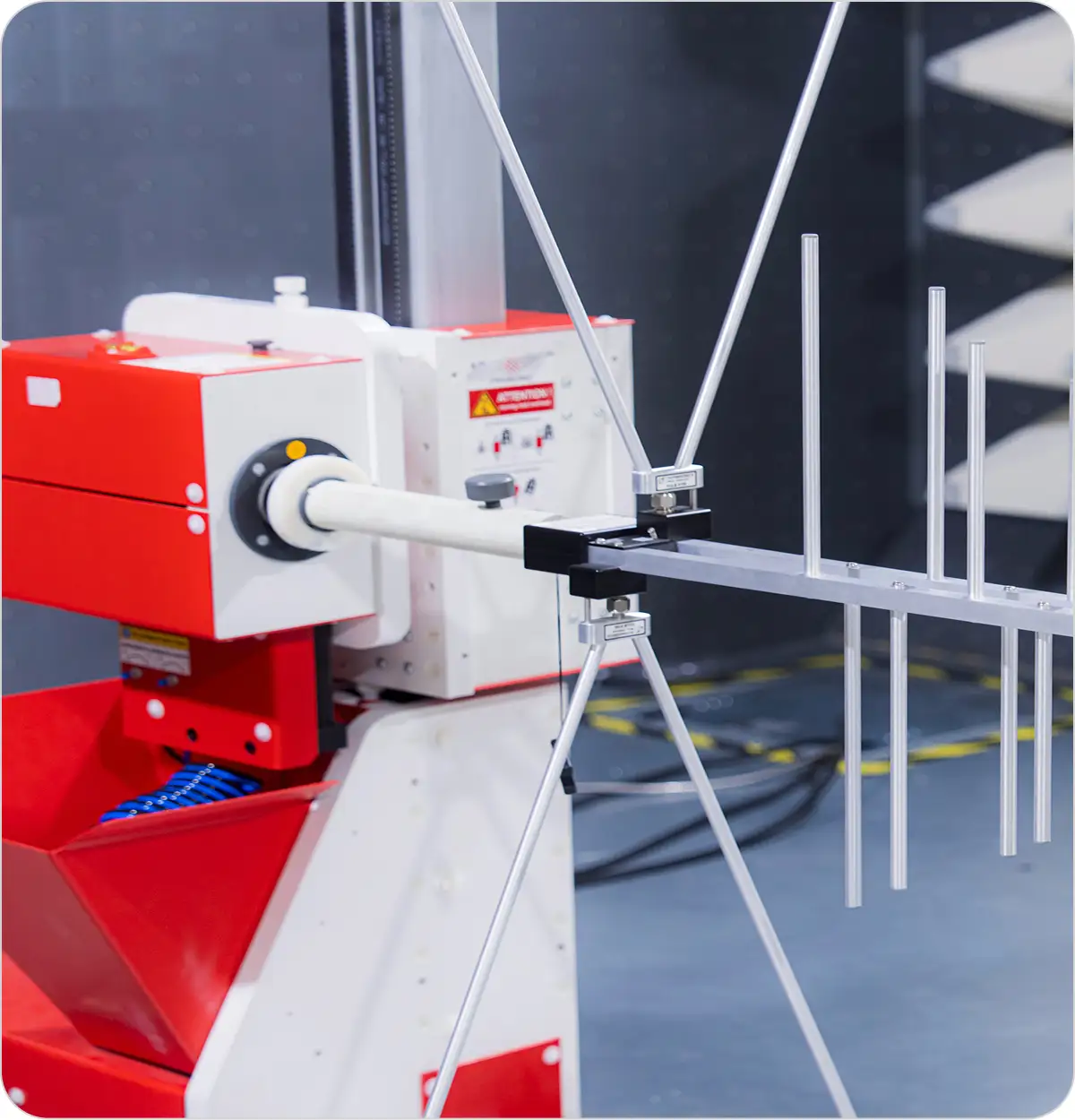
IEC 61000-4-3 — Radiated RF Immunity 3 V/m, 80 MHz–1 GHz.
Mimics the RF field you’d get near radio transmitters, mobile phones, and wireless gear, confirming the product keeps working when exposed to it.
IEC 61000-4-4 — Electrical Fast Transient / Burst ±1 kV on power ports, ±0.5 kV on signal/control lines.
Recreates the effect of switching inductive loads — motors, relays — sharing the same circuit.
IEC 61000-4-5 — Surge ±0.5 kV (line-to-line) / ±1 kV (line-to-earth) on AC mains.
Simulates indirect lightning strikes and grid switching events. Any mains-connected product needs to pass this one.
IEC 61000-4-6 — Conducted RF Disturbances 3 V (r.m.s.), 0.15–80 MHz.
Checks how the product handles RF picked up on cables from nearby transmitters, by injecting a modulated signal through a coupling network.
IEC 61000-4-8 — Power Frequency Magnetic Field 3 A/m at 50/60 Hz.
Matters most for products with magnetic-sensitive parts, like certain sensors or displays, confirming nearby power wiring won’t throw off performance.
IEC 61000-4-11 — Voltage Dips and Short Interruptions
Voltage drops of 30–100% for set durations, simulating mains disturbances from big load switching or grid faults. Equipment needs to ride these out without behaving unsafely.
Immunity IEC/EN 61000-6-2 — Industrial Environments
This covers immunity requirements for equipment used in industrial settings. Since industrial environments deal with rougher disturbances — big motors, switching gear, welding equipment — the immunity levels required under IEC 61000-6-2 are generally tougher than those in IEC 61000-6-1.
Emissions IEC/EN 61000-6-3 — Residential, Commercial & Light Industrial
This standard sets conducted and radiated emission limits for equipment that plugs into the public low-voltage mains ( e.g., homes, offices, shops, and light workshops). Because the public mains also feeds broadcast receivers and everyday consumer electronics, these limits are the tightest in the whole generic series.
IEC 61000-6-3 covers conducted emissions (disturbances fed back onto the mains) and radiated emissions (energy broadcast into the surrounding space). It defines which phenomena apply and what limits to use, while the actual measurement methods come from CISPR 32 and CISPR 11.
Conducted Emissions — Mains Port (150 kHz–30 MHz)
Measured with a Line Impedance Stabilization Network (LISN), with limits set as both quasi-peak and average values. For Class B (residential) equipment, these limits are the strictest in the whole CISPR framework — 5–10 dB tighter than industrial limits — since the public mains feeds straight into sensitive consumer electronics throughout a home.
Radiated Emissions (30 MHz–1 GHz, up to 6 GHz for digital devices)
Measured at a standard 10 m distance, either on an open area test site (OATS) or in an accredited semi-anechoic chamber. The standard applies Class B limits from CISPR 32 and CISPR 22, which run 6–10 dB below the Class A (industrial) limits in the most critical frequency bands.
∿ Harmonic Currents and Voltage Fluctuations
For equipment drawing up to 16 A per phase with rated power above 75 W, the standard also pulls in IEC 61000-3-2 for harmonic current limits and IEC 61000-3-3 for voltage fluctuations and flicker. These rules exist to keep the public grid from degrading when large numbers of residential devices draw non-sinusoidal current.
Emissions IEC/EN 61000-6-4 — Industrial Environments
This standard sets emission limits for equipment built for industrial settings — usually places fed by their own dedicated transformer rather than the public grid. The limits are looser than IEC 61000-6-3’s because industrial environments can handle more background electromagnetic noise. It’s commonly applied to control panels, industrial drives, and factory equipment.
CE Marking and Harmonized Standards
Under the EU EMC Directive (2014/30/EU), EN 61000-6-3 and EN 61000-6-1 count as harmonized standards. Passing both helps support the presumption of conformity and the Declaration of Conformity you need for CE Marking. If your product is heading to both the EU and North America, our engineers can bundle CE testing with FCC or ICES testing into one test campaign, saving you time and money.